
Key takeaways
- Technical rank and teaching ability are separate skills, and both are trained deliberately.
- Staff work through Kovar Systems instructor training plus ongoing continuing education.
- Coaching methodology covers child development, learning science and positive behavior strategies.
- Teaching is our staff's profession, not a side interest.
Two different skills
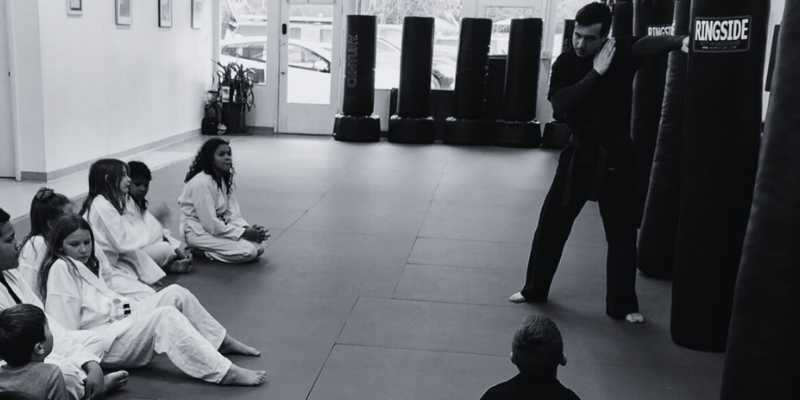
A high rank tells you someone can perform a martial art. It says nothing about whether they can explain it to a nervous six-year-old, notice which student in the back row has stopped trying, or adjust a drill on the spot for a child who cannot yet cross the midline.
Those are teaching skills, and they are learnable. We treat them the way we treat technique: as a curriculum with a progression, standards and continuing practice.
Kovar Systems instructor training
Our staff train through Kovar Systems, an instructor development program used by martial arts schools nationwide. It covers the mechanics of running a class: how to structure a lesson so energy and attention hold, how to give a correction that a child can actually use, how to manage a room of twenty students without raising your voice, and how to keep every student engaged rather than only the confident ones.
It is systematic and it is repeatable, which matters. It means a family gets a consistent standard of instruction regardless of which coach is on the mat that day.
- Lesson structure and pacing for different age groups
- Giving corrections in a form students can act on
- Class management that keeps the room calm rather than controlled by volume
- Keeping quieter and less confident students engaged
Continuing education, not a one-time certificate
Instructor training is not something our staff completed once and filed away. Coaches continue their own technical training under senior instructors, attend ongoing instructor development, and review classes together — what worked, what did not, which students need a different approach next week.
New coaches also come up through a mentored pathway: assisting first, then leading portions of class under supervision, then leading a class with a senior instructor available. Nobody is handed a room of children on their first day.
Child development and learning science
Coaching a four-year-old and coaching a twelve-year-old are not the same job. Attention span, working memory, the ability to hold multi-step instructions, coordination milestones and how much abstraction a child can handle all change with age. Our instructor training covers these stages so class design matches the group.
That is why Little Dragons classes are 40 minutes with frequent changes of activity, while Dragons classes run 45 minutes with real technical curriculum and more independence. The differences are deliberate, not arbitrary.
Learning science shows up in how skills are broken down and rehearsed: small pieces, repeated with variation, revisited across weeks rather than crammed into one class. This is unglamorous and it is what makes skills stick.
Positive behavior strategies
Our coaches are trained to run a class on clear expectations and specific recognition rather than on discipline for its own sake. Specific praise — 'good job keeping your hands up on that last one' — teaches. Generic praise does not, and shouting teaches only who is loudest.
When a student is having a hard class, the first response is a change in the environment: a different partner, a shorter rep, a job to do, a moment at the edge of the mat. Removing a child from the group is a last step, not a first one.
These are teaching strategies for the mat. They are not behavioral therapy, and we do not diagnose or treat any condition.
Teaching the individual child
The most important thing our staff are trained to do is notice. Two students in the same class doing the same drill often need opposite things: one needs a harder version to stay interested, the other needs the same rep three more times before it makes sense.
This is why coaches learn names quickly and why they talk to each other about students between classes. A child who is quiet for three weeks in a row is a conversation, not a data point.
It is also why we offer private lessons when a group class is not the right setting for a particular skill or a particular week. Not as an upsell — as a tool.
This is our staff's profession
Elevate has taught in Lake County for more than 20 years. Our instructors are not volunteers filling a slot; teaching is what they do and what they keep getting better at.
The practical difference shows up in the boring places: classes that start on time, curriculum that actually progresses, coaches who remember what your child struggled with last week, and consistent answers to your questions from whoever you happen to ask.
Common questions
Parent Pro Tip
The coach matters more than the style for the first two years. Almost every beginner question — will they stick with it, will they feel safe, will they be corrected kindly — is answered by the person on the floor, not by the name above the door.
- Ask how instructors are trained and supervised.
- Watch how a mistake is handled, not how a black belt performs.
- Choose the schedule you can actually make twice a week.
From the Elevate Martial Arts coaching staff — general guidance, not professional advice.
About the author
Elevate Martial Arts Instructional Team
Coaches, Middletown & Clearlake
Our coaching staff has taught children, teens and adults in Lake County for more than 20 years. Guides in the Learning Center are written from what we see in class each week and reviewed by the instructional team before publishing. They are general educational information, not medical, psychological or legal advice.
About this guide
- Describes Elevate's own instructor training and mentoring practices, including participation in Kovar Systems instructor development.
- No external research is cited and no outcome is promised.
- Reviewed by the Elevate Martial Arts instructional team.
- General educational information only — not medical, psychological or legal advice.