
Key takeaways
- Readiness is a starting point, not a finished skill set; a preschool class should teach group behavior rather than demand mastery of it.
- Look for moments of capacity — brief listening, imitation, recovery and curiosity — rather than expecting forty straight minutes of compliance.
- The right question is often whether the class is ready for your child, not whether your child is ready for the class.
The readiness test parents accidentally set too high
Parents often picture readiness as a child who walks into a room, separates cheerfully, stands still, listens the first time, waits without touching anyone, remembers two instructions and completes the whole class without needing help. That child exists occasionally. They are not the admission standard for preschool.
Three- and four-year-olds are still learning what a group is. They are learning that another adult can give them a direction, that the other children also get turns, that an exciting idea can wait, and that a transition means the previous activity is actually over. If a class only works for children who already do all of that, it is not really a preschool class; it is an older-child class with younger bodies in it.
Look for moments of readiness, not forty perfect minutes
A useful way to judge readiness is to look for short moments your child can already produce. Can they copy you when you clap twice? Can they put something away after one reminder? Can they wait while another child goes down the slide? Can they return after wandering off? Can they become interested when an adult demonstrates something physical? Those small moments are enough material for a good instructor to work with.
The important word is sometimes. A tired preschooler may lose skills they showed yesterday. Excitement can make a capable child look completely unready for the first ten minutes. The point of a repeated weekly class is that the child gets dozens of low-stakes attempts at the same routines until they become familiar.
- Can imitate one simple movement when interested
- Can follow a one-step direction some of the time
- Can wait briefly with an adult's support
- Can rejoin after becoming distracted
- Shows curiosity about the activity or the other children
Separation is a skill, not an entrance exam
Some preschoolers separate from a parent on the first day. Others need the parent visible for several classes before they stop checking the room every thirty seconds. We do not read that difference as confidence versus weakness. It is simply where the child is beginning.
What matters more is direction of travel. A child who spends most of class near the edge in week one, joins two activities in week two and forgets to look for the parent during a game in week three is learning the class. That is progress even if the goodbye still has tears. A program that understands preschoolers should have room for that gradual handoff.
Do not require the class to be unnecessary
There is a circular mistake in waiting for a child to master listening, turns, transitions and independence before enrolling them in an activity designed to practice listening, turns, transitions and independence. A good preschool program should make those things part of the curriculum through repetition rather than through lectures.
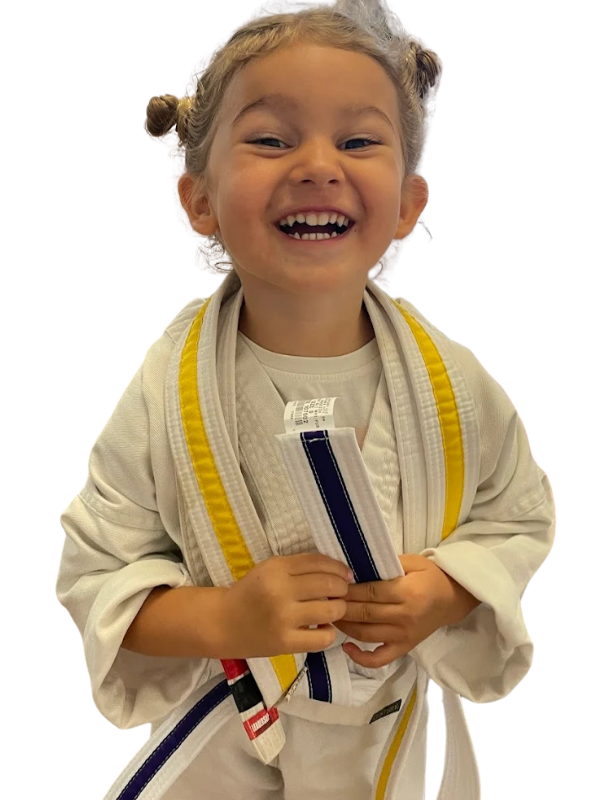
At Elevate, Little Dragons uses short instructions, marked places to stand, repeated opening and closing routines, quick activity changes and physical demonstrations. Those are not decorations around the martial arts. For this age, learning how to function inside that structure is one of the main things being practiced.
When waiting a few months may genuinely be better
There are times when the kindest answer is not yet. If every visit to the room produces escalating distress that does not settle at all, if the child cannot engage with any part of the activity even with one-to-one support, or if the class time consistently collides with sleep, food or another predictable pressure point, forcing the issue rarely improves the experience.
Waiting is not falling behind. At this age, three months can change the experience dramatically. A child who was overwhelmed in September may walk in happily in December because language, familiarity and daily routines have all moved. The goal is not to start at the earliest possible birthday. The goal is to find the point where the class can become a place of practice rather than a weekly battle.
If you have broader concerns about your child's development, communication, hearing, movement or regulation across settings, discuss those with your pediatrician or another qualified professional rather than trying to diagnose readiness from an activity class.
What a realistic first month looks like
The first month is usually uneven. One class may look wonderful and the next may look as though the child has forgotten the entire concept. That is normal. Preschool learning is strongly affected by sleep, hunger, novelty, illness and who else is in the room, so a single difficult day tells you very little.
We would judge the first four to six classes by participation trends rather than performance. Is the child entering the room more easily? Do they know where shoes go? Are they joining the opening routine faster? Can they recover from correction with less help? Are they beginning to anticipate what comes next? Those are the early wins that matter.
- Week 1: learn the room and the adults
- Week 2: recognize the basic sequence
- Weeks 3–4: join more quickly and need fewer prompts
- Weeks 4–6: begin carrying small routines independently
Sometimes the program is the thing that is not ready
A three-year-old who struggles in a loud, hour-long, mixed-age class may do beautifully in a forty-minute class built specifically for preschool attention. That difference matters. Before concluding that your child cannot handle structured activities, look at what the structure is asking of them.
Watch how instructors respond when a child drifts. Do they get closer and simplify the direction, or do they repeat it louder from across the room? Are there frequent transitions? Are children expected to stand still while adults talk? Does correction preserve the child's dignity? A preschool program should be designed around the developmental reality in front of it, not around the convenience of teaching every age the same way.
Common questions
About the author
Elevate Martial Arts Instructional Team
Coaches, Middletown & Clearlake
Our coaching staff has taught children, teens and adults in Lake County for more than 20 years. Guides in the Learning Center are written from what we see in class each week and reviewed by the instructional team before publishing. They are general educational information, not medical, psychological or legal advice.
About this guide
- Written from what Elevate coaches see week to week in Little Dragons classes for ages 3–4 in Middletown.
- General educational information for parents. It is not medical, developmental, psychological or diagnostic advice, and no outcome is promised.
- Reviewed by the Elevate Martial Arts instructional team.
- General educational information only — not medical, psychological or legal advice.