
Key takeaways
- Fear-based compliance and genuine respect can look similar but behave very differently when no adult is present.
- Respect is taught more through consistent, predictable follow-through than through the severity of consequences.
- Modeling respectful behavior toward children is one of the strongest predictors of respectful behavior from children.
- Mutual courtesy — expecting respect to flow both directions — tends to build more durable habits than one-directional demands.
Two kinds of 'well-behaved'
It is possible to get a child to sit still, lower their voice, or say 'yes ma'am' through fear of what happens if they don't. It is also possible to get the same behaviors because a child has internalized why they matter. From the outside, in a single moment, these can look identical.
The difference shows up later — when the parent leaves the room, when a substitute teacher is in charge, or when the child is a teenager and the original consequences no longer feel like much of a threat. Behavior built on fear tends to be situational: present when the enforcer is present, absent otherwise. Behavior built on genuine respect tends to travel with the child.
Why fear-based approaches tend to backfire
Raising your voice, using harsh punishment, or relying on intimidation can produce quick compliance, which is exactly why it is tempting in a stressful moment. But the lesson a child actually absorbs is often 'don't get caught' rather than 'this matters.'
Over time, fear-based approaches can also damage the relationship that makes a child want to listen to you in the first place. A child who is afraid of a parent's reaction is less likely to come to that parent with a real problem, which matters far more as children get older and the stakes of what they're hiding get higher.
Consistency does more work than severity
One of the most reliable ways to build respect for boundaries is simple, unglamorous consistency: the same expectation, communicated calmly, followed through the same way every time. Children test boundaries not because they are defiant by nature, but because they are checking whether the boundary is real.
A rule enforced calmly and consistently ninety percent of the time teaches more than a rule enforced with intense reactions ten percent of the time. Predictability, more than intensity, is what tells a child a boundary can be trusted.
Modeling respect, including toward your child
Children learn a great deal about what respect looks like by watching how they themselves are treated. A parent who listens when a child speaks, apologizes when they've made a mistake, and asks rather than only demands is teaching respect as a two-way expectation, not a one-way rule that only applies to kids.
This does not mean treating a child as an equal decision-maker in matters that are a parent's responsibility to decide. It means the tone of everyday interactions — how requests are made, how mistakes are handled, how disagreements are discussed — sets the template your child will use with you and eventually with others.
Respect as mutual courtesy
Framing respect as something owed only upward — from child to parent, from student to teacher — tends to produce resentment once a child is old enough to notice the asymmetry. Framing it as mutual courtesy, where politeness, attentiveness and follow-through are expected from everyone in the relationship, tends to be both more honest and more durable.
In practice, this can be as simple as saying 'please' and 'thank you' to your child the same way you expect it from them, or explaining briefly why a rule exists instead of only stating that it exists. Children who understand that respect is a shared standard, not a punishment-avoidance system, tend to carry it into rooms where no one is enforcing anything.
How Elevate can help
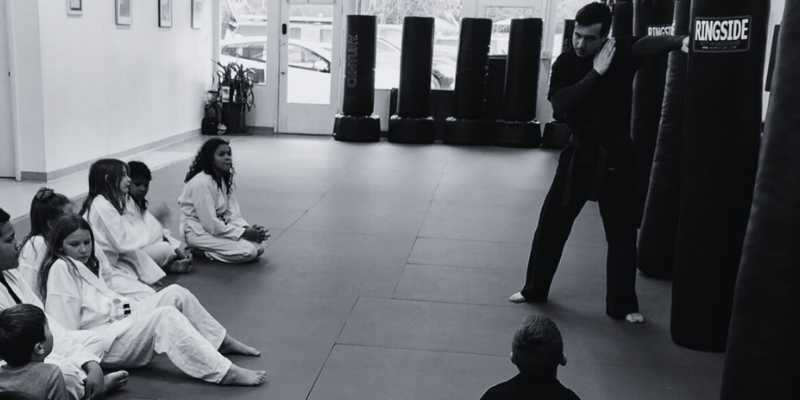
In class, respect is taught as mutual courtesy from day one — students bow to the coach, and the coach acknowledges the student in return; a student who helps a partner up is thanked, not simply expected to do it. Nothing about the structure relies on intimidation. Coaches set a clear, consistent standard and hold it the same way every class, which is exactly the kind of predictable follow-through that builds real respect rather than fearful compliance.
Our instructors train through the Kovar Systems curriculum and ongoing continuing education specifically in how to hold a firm standard while keeping the room warm and encouraging — correcting behavior without shaming a child in front of peers. That balance is deliberate: students learn that a boundary can be firm and unwavering without being frightening.
Because the same expectations apply to every student, every class, children get weekly practice at behaving respectfully because it's simply how the room works — not because a specific adult is watching for a slip-up. Many parents notice that this consistency starts to show up at home too, as children bring the same calm, respectful habits into everyday family life.
Common questions
Parent Pro Tip
Say the standard once, then let the routine carry it. Families who repeat expectations twenty times a week are usually doing the remembering on the child's behalf. A visible routine — a list, a whiteboard, a fixed order of operations — transfers that job to the system instead of your voice.
- Write the routine where everyone can see it.
- Point at the list instead of repeating the instruction.
- Follow through the first time, calmly, so the list means something.
From the Elevate Martial Arts coaching staff — general guidance, not professional advice.
About the author
Elevate Martial Arts Instructional Team
Coaches, Middletown & Clearlake
Our coaching staff has taught children, teens and adults in Lake County for more than 20 years. Guides in the Learning Center are written from what we see in class each week and reviewed by the instructional team before publishing. They are general educational information, not medical, psychological or legal advice.
About this guide
- Written from how Elevate structures its curriculum, coaching and family communication in Middletown and Clearlake.
- General educational information for families. No external research is cited and no outcome is promised.
- Reviewed by the Elevate Martial Arts instructional team.
- General educational information only — not medical, psychological or legal advice.