
Key takeaways
- Executive function is a set of practicable skills, not a measure of how smart or willing a child is.
- Movement-based settings make the next action visible, which lowers the memory load.
- At home, one clear cue usually outperforms five repeated directions.
What the term actually covers
Executive function is a convenient label for the set of skills a person uses to get something done: holding an instruction in mind, getting started, sequencing the steps, resisting the interesting distraction, changing course when the situation changes, and finishing rather than drifting.
It is worth saying plainly that these skills develop at very different rates in different children, and that a child who struggles with them is not being lazy or defiant. It is also not our place to label anything. This guide describes practice, not assessment.
- Working memory: holding one to three steps while doing the first one
- Task initiation: the gap between knowing and starting
- Sequencing: putting steps in a workable order
- Cognitive flexibility: adjusting when the plan changes mid-task
- Completion: finishing the last, least interesting part
How a class rehearses the same sequence
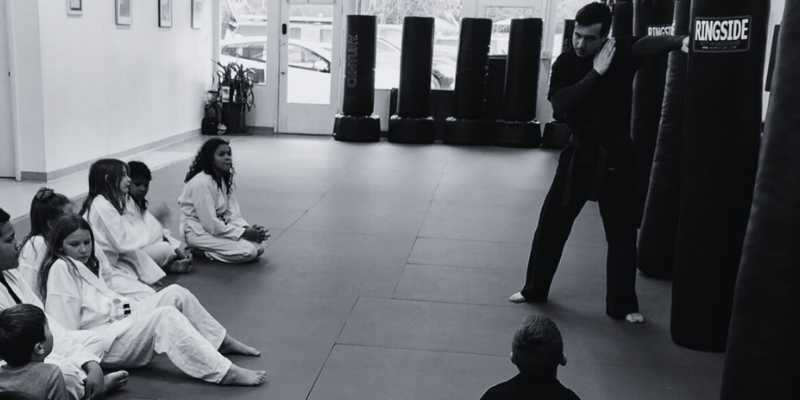
A martial arts class runs on short cycles: listen, remember, begin, adjust, finish. A coach gives one to three steps, the student starts within a few seconds, the coach corrects, the student adjusts and completes the repetition. Then it happens again. In a forty-five minute class a student may run that loop dozens of times.
The reason movement helps is not mysterious. When the next action is physical and visible, a student can see what the finished thing looks like and can be redirected without a long verbal explanation. The feedback is immediate rather than arriving on a report a week later.
We do not ask children to "focus harder." We make the next action clear.
Why short instructions and predictable routines support participation
Classes at Elevate follow a familiar shape each week — the same opening, the same expectations at the edge of the mat, the same way corrections are given. Predictability frees up attention. A student who already knows what happens next can spend their effort on the skill instead of on figuring out the room.
Instruction length matters too. A long explanation asks a student to store several steps before they have done any of them. Two steps, an attempt, then two more steps keeps the memory load inside what most children can hold.
- One to three steps per instruction, then an attempt
- A consistent routine so attention is not spent on the format
- Movement between instructions rather than long stretches of standing
- Corrections given as the next action, not as a critique of the last one
Practical carryover at home
The most common thing we hear from parents is that they repeat themselves all evening. Repetition rarely solves an executive-function bottleneck; it usually adds noise. Try changing the structure of one routine rather than the volume of the reminders.
Pick a single routine — the morning bag, homework start, or bedtime — and work on that one for a few weeks. Adding structure to everything at once tends to collapse by Wednesday.
- Give one clear cue and wait, instead of repeating the direction three times
- Ask the child to say the step back to you before starting
- Prepare visually: the bag by the door, the uniform out the night before
- Finish one step before adding the next, even if it is slower
- Name the finish so it registers: "That is done. What is next?"
Elevate does not diagnose or treat ADHD, learning differences or executive-function difficulties. If you have concerns about your child's attention, learning or development, your pediatrician or your school's support team is the right starting point.
Common questions
Parent Pro Tip
Shorten the instruction, not the expectation. Attention holds far better across several short, clearly bounded tasks than across one long, vague one. Coaches do this instinctively — "three reps, then look at me" — and it works just as well at a kitchen table.
- Give one step at a time and ask for it back in their words.
- Build in movement between blocks rather than treating movement as a reward.
- Keep the standard the same; change the size of the chunk.
From the Elevate Martial Arts coaching staff — general guidance, not professional advice.
About the author
Elevate Martial Arts Instructional Team
Coaches, Middletown & Clearlake
Our coaching staff has taught children, teens and adults in Lake County for more than 20 years. Guides in the Learning Center are written from what we see in class each week and reviewed by the instructional team before publishing. They are general educational information, not medical, psychological or legal advice.
About this guide
- Written from what Elevate coaches see week to week in Middletown and Clearlake classes.
- General educational information for families. No external research is cited and no outcome is promised.
- Reviewed by the Elevate Martial Arts instructional team.
- General educational information only — not medical, psychological or legal advice.