
Key takeaways
- Bullying is repeated, intentional, and involves a power imbalance — that distinction changes the response.
- Specific questions get real answers; "how was school?" almost never does.
- Assertive is calm, brief and boundaried. It is not aggressive, and it is not silent.
- Write incidents down with dates, then bring the record to the school rather than a general concern.
What is the difference between conflict, teasing and bullying?
These words get used interchangeably, and the response should be different for each. Conflict is a disagreement between two children with roughly equal footing — an argument over a game, a fallout between friends. It is uncomfortable, normal, and one of the main ways children learn to negotiate.
Teasing is often mutual and can even be affectionate, though it turns quickly when one side stops enjoying it and it continues anyway.
Bullying has three markers that set it apart: it repeats, it is intended to hurt or exclude, and there is a power imbalance — size, age, status, numbers, or information. Exclusion and rumour-spreading count. So does harassment through phones and group chats, which is why the school day no longer ends at 3 p.m.
- Conflict: two children, roughly equal power, resolvable with coaching
- Teasing: mutual banter, becomes harmful when it continues after someone stops laughing
- Bullying: repeated, deliberate, unequal — needs adult involvement
Naming it accurately in front of your child matters. Calling ordinary conflict bullying can make a child feel more powerless than they are; calling bullying "just kids being kids" leaves them alone with it.
What are the warning signs of bullying?
Most children do not report it directly. Shame, fear of making it worse, and worry about losing phone or activity privileges all get in the way. What parents usually notice first is a change in pattern.
- Lost or damaged belongings, or unexplained missing money
- Reluctance to go to school, or new stomach aches and headaches on school days
- Taking a longer route home, or avoiding the bus
- A sudden shift in friend group, or eating lunch alone
- Sleeping badly, mood changes after being on a phone, or deleting apps abruptly
- Vague comments — "everyone hates me", "our class is dumb" — without specifics
Any one of these on its own is usually nothing. A cluster that persists for a couple of weeks is worth gentle, specific questions.
How to ask better questions
"How was school?" is answerable with one word, so it usually is. Specific, low-stakes questions get much further, especially sideways — in the car, on a walk, while cooking, where eye contact is optional.
Ask about the structure of the day rather than about feelings. Where a child sits, who they walk with, what happens at lunch and on the bus is where most of it happens.
When something does come out, the hardest part is your reaction. Big alarm teaches a child to protect you from the next thing they hear. Steady, believing, and slow is what keeps the conversation open.
- "Who did you sit with at lunch today?"
- "Who's the funniest person in your class right now? Who's the hardest to be around?"
- "What happens on the bus in the afternoon?"
- "If someone in your grade was having a rough time, who would notice?"
- "Has anything happened lately that you didn't tell me about because you thought I'd overreact?"
Parent Pro Tip
Promise a process, not silence. Never promise "I won't tell anyone" — instead say "I won't do anything without talking it through with you first." That keeps the trust and keeps your options open.
Assertive, not aggressive: words children can practise
Assertive means calm voice, upright posture, short sentence, then leaving. It is not a comeback contest and it is not a fight. Most escalation happens when a child either freezes or matches the aggression, and both are avoidable with practice.
Practise the words out loud at home until they are boring. In the moment, children do not improvise — they use whatever is automatic. Rehearsing at the kitchen table is what makes a phrase available in a hallway.
The tone rule is the whole skill: flat and unbothered, not angry, not pleading. Say it once, then walk toward an adult or a group.
- "Stop. I don't like that."
- "That's not okay. I'm done talking about it."
- "You can think that. I'm going now."
- "Not interested." — then turn and walk
- To a bystander: "Come with me, I need to find Ms. Reyes."
- To an adult: "I need to tell you something that keeps happening."
Getting to an adult is a skill too. Teach your child which specific staff member they will go to, by name, and where that person usually is.
When and how to involve the school
Report a single serious incident immediately. For patterns, keep a short written record first: date, time, place, what happened, who was there, what your child did, what any adult did. Screenshot anything digital before it is deleted.
A record changes the conversation. Schools are required to respond to reported incidents, and a specific log of five dated events is far more actionable than "my son is being picked on".
Start with the teacher, then escalate to the principal or district office if the pattern continues, keeping everything in writing. Ask two direct questions: what is the plan, and when will we check in again. California districts, including those across Lake County, publish anti-bullying and complaint policies — ask your school office for their current procedure and timelines.
- Log every incident with date, place, people and outcome
- Screenshot messages, posts and group chats before they disappear
- Email after any meeting to summarise what was agreed
- Ask for a named point of contact and a review date
Helping a child who sees it happen
Most children are witnesses far more often than targets, and what witnesses do has real influence on whether it continues. The ask is not heroism — it is small, safe, repeatable action.
Give them three options and let them choose in the moment: interrupt harmlessly ("hey, the teacher's looking for you"), remove the target ("come sit with us"), or report it to a named adult afterwards. Checking in privately later — a text, a seat saved at lunch — matters more than most children realise.
Say out loud that telling an adult about something dangerous or repeated is not tattling. Many children need explicit permission for this, especially between the ages of eight and twelve.
Confidence, boundaries and what martial arts is actually for
Children who carry themselves with steadiness — head up, clear voice, comfortable saying no — tend to be approached differently. That is not a promise of protection, and it is never the target's fault when someone chooses to bully them. It is simply one of the few things we can practise directly.
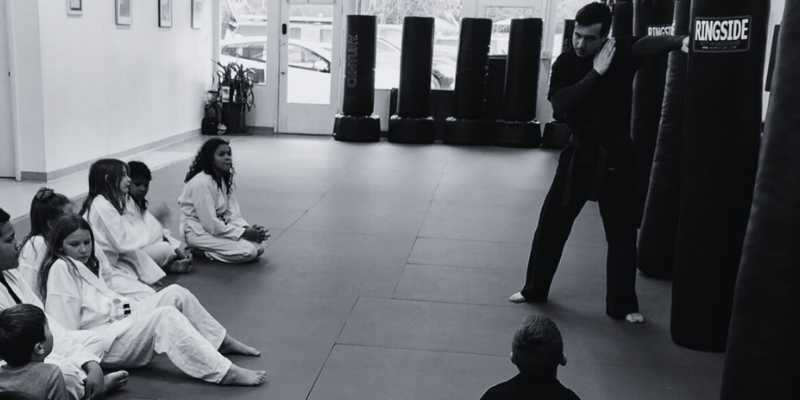
This is the honest role a good martial arts program plays, and it is worth being clear about the limits. In our classes, students practise saying no in a firm voice, standing their ground with calm posture, finding an adult, and walking away from something that is escalating. Awareness, voice and de-escalation come first; physical skills are the last resort, taught for genuine safety, and never for use at school.
Any program that promises your child will stop being bullied, or that encourages handling it physically, is selling something. What weekly training can offer is practice at speaking up, tolerating discomfort, and belonging to a group where the standard for how people are treated is set out loud.
If bullying is the specific reason you are considering a class, our guide on martial arts and bully prevention goes further, and you are welcome to visit a class in Middletown or Clearlake and watch before deciding anything.
Parent Pro Tip
Rehearse the exact phrase and the exit together, twice a week, until it is automatic. Children default to what they have practised, not to what they have been told.
Common questions
Parent Pro Tip
Decide together, in advance, on one named adult at school your child will go to and where to find them. In the moment children rarely search for help — they go where they have already decided to go.
- Name the go-to staff member and their usual location
- Practise one assertive phrase out loud until it is boring
- Start a dated incident log the first time something repeats
From the Elevate Martial Arts coaching staff — general guidance, not professional advice.
About the author
Elevate Martial Arts Instructional Team
Coaches, Middletown & Clearlake
Our coaching staff has taught children, teens and adults in Lake County for more than 20 years. Guides in the Learning Center are written from what we see in class each week and reviewed by the instructional team before publishing. They are general educational information, not medical, psychological or legal advice.
About this guide
- Written from what Elevate coaches see each August with returning and brand-new students in Middletown and Clearlake.
- General educational information for families. Nothing here is medical, psychological or legal advice, and no outcome is promised.
- Reviewed by the Elevate Martial Arts instructional team.
- General educational information only — not medical, psychological or legal advice.