
Key takeaways
- Friendship is built through repeated contact over time, not a single successful interaction.
- Children differ widely in temperament — some need more reps than others, and that's normal variation.
- A stable, recurring peer group gives more chances to build familiarity than one-off events.
- Shared activity, not just shared space, tends to give children something to bond over.
Why friendship takes longer for some kids
Some children strike up friendships easily; others need more exposure to the same peers before a relationship forms. Neither pattern is a problem on its own — it reflects temperament as much as anything else. A more cautious or observant child often takes longer to warm up, and then forms friendships that are just as real and durable.
It is worth remembering that friendship is also somewhat outside a child's control. It depends on finding another child with compatible interests and timing, which a parent cannot fully engineer no matter how many playdates get scheduled.
The ingredient that matters most: repetition
Familiarity tends to build gradually. Children who see the same faces week after week — in a classroom, on a team, in a class — get more chances to move from stranger to acquaintance to friend than children who only see peers in scattered, one-off settings.
This is why a single playdate or a single birthday party rarely 'fixes' a friendship gap. One good afternoon is a start, not a friendship. What tends to help more is a setting your child returns to reliably, with mostly the same group of kids, over months.
- Same peer group, seen weekly or more often
- A shared activity to focus on, rather than unstructured hanging out
- Enough time — think months, not weeks — for familiarity to build
What parents can do at home
Rehearsing a few simple opening lines can lower the barrier to a first conversation — "what are you working on?" or "can I try that?" are easier to say out loud after they've been practiced once at home.
It also helps to resist the urge to over-narrate your child's social life ('why didn't you talk to anyone today?'). A light touch — checking in without turning every day into a debrief — usually keeps the topic from feeling like pressure.
If your child seems anxious rather than simply slow to warm up, that anxiety is worth discussing with a pediatrician or school counselor rather than working through alone.
How Elevate can help
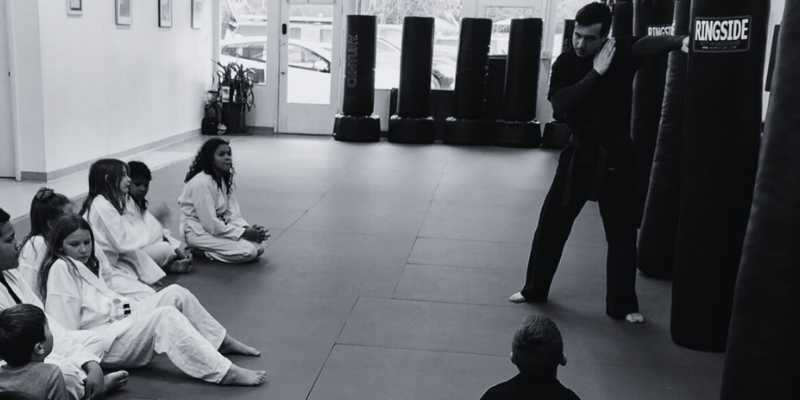
A weekly martial arts class is, structurally, close to the ideal setup for building the kind of familiarity friendship needs: the same group of students, in the same room, working toward the same goals, week after week.
Coaches — trained through the Kovar Systems program and continuing education — deliberately assign training partners rather than letting students default to whoever they already know. That means a child gets repeated, structured practice interacting with classmates they might never approach on their own, which widens their circle of familiar faces over time.
The activity itself also gives children something to talk about that isn't small talk — a technique they're both working on, a belt test coming up, a drill that went well. Consistent expectations and individualized instruction mean every student, regardless of how outgoing they are, gets the same weekly reps.
Little Dragons (ages 3–4, 40 minutes) and Tigers (5–8) build early comfort working with different partners; Dragons (9–12, 45 minutes) and Teens on the adult schedule add more responsibility and leadership opportunities, like helping a newer student, which give older kids a natural, low-pressure reason to talk to someone new.
What a realistic timeline looks like
It is reasonable to expect gradual change rather than an overnight shift. Many families notice their child starting to mention a classmate by name, or asking if a particular friend will be at the next class, somewhere in the first few months of steady attendance — not the first few weeks.
Patience matters here. A child who is quietly observing a group for a while before engaging is often building the comfort they need, even if it doesn't look like progress from the outside.
Common questions
Parent Pro Tip
Shared activity beats forced conversation. Children make friends sideways — while doing something together — far more easily than face to face. Any setting with the same faces, a shared task and a predictable weekly slot gives friendship a chance to form without a child having to perform.
- Prioritise repetition over variety: the same group every week beats five different ones.
- Arrive five minutes early. Most connection happens before the activity starts.
- Ask "who did you work with?" rather than "did you make a friend?"
From the Elevate Martial Arts coaching staff — general guidance, not professional advice.
About the author
Elevate Martial Arts Instructional Team
Coaches, Middletown & Clearlake
Our coaching staff has taught children, teens and adults in Lake County for more than 20 years. Guides in the Learning Center are written from what we see in class each week and reviewed by the instructional team before publishing. They are general educational information, not medical, psychological or legal advice.
About this guide
- Written from how Elevate structures its curriculum, coaching and partner assignment in Middletown and Clearlake.
- General educational information for families. No external research is cited and no outcome is promised.
- Reviewed by the Elevate Martial Arts instructional team.
- General educational information only — not medical, psychological or legal advice.