
Key takeaways
- Independence is built through repeated practice with real tasks, not a single talk about responsibility.
- Tasks should be sized to the child's actual ability, then increased gradually as they show they can handle more.
- Letting natural, low-stakes consequences play out teaches faster than rescuing a child from every mistake.
- Praise the process — the attempt, the problem-solving — more than the outcome.
What independence actually is
Independence isn't a personality trait some children have and others lack. It's a stack of small, specific skills — remembering their own things, starting a task without a reminder, recovering from a mistake without panic — built through repeated, low-stakes practice over time.
Because it's built through practice rather than declared in a conversation, the fastest way to grow it is to hand over real tasks, let the child actually own the outcome, and resist the urge to step in the moment something goes slightly wrong.
Why over-helping slows things down
It's often faster and less stressful in the moment for a parent to just do the thing — pack the backpack, remind them three times, fix the mistake before anyone notices. The tradeoff is that each rescue removes a small rep the child needed in order to learn to do it themselves.
Over time, a pattern of consistent rescuing can teach a child, without anyone intending it, that someone else will handle the parts that go wrong. That's not a character flaw — it's a learned expectation, and learned expectations can be un-learned by changing what actually happens when things go wrong.
Size the task to the child, then raise it
The right amount of independence to hand over is whatever is just slightly harder than what a child can currently do comfortably — enough to stretch them, not so much that they're set up to fail. This looks different at every age and changes as they grow.
- Ages 5–8: pack their own school bag with a checklist, choose their own clothes, carry their own water bottle
- Ages 9–12: manage a homework folder, set their own alarm, handle a simple chore start-to-finish without reminders
- Teens: manage their own schedule and deadlines, handle a part-time responsibility, make their own decisions about time management with parents available as backup
If a task consistently ends in frustration or failure, it may be sized a step too big for right now — scaling it back briefly and building up again usually works better than pushing through.
Let low-stakes mistakes play out
A forgotten homework folder, a missed alarm, a chore left undone — these are exactly the kind of low-stakes mistakes that teach more effectively when a parent doesn't step in to fix them. A child who experiences the actual, mild consequence of forgetting something is more likely to remember it next time than one who is bailed out every time.
This isn't about withholding help out of principle. It's a judgment call: is the mistake genuinely low-stakes, and is there a real lesson to be learned from letting it play out? If yes, stepping back is usually the more useful choice than stepping in.
Praise the effort, not just the result
How independence gets responded to matters as much as how much is handed over. Praising the attempt — 'you figured that out yourself' — rather than just the outcome reinforces the behavior parents actually want to see repeated: trying something without being told, and working through it when it doesn't go smoothly the first time.
This is a small shift in language with a real effect over time. Children who are consistently praised for outcomes alone can become cautious about attempting things they're not sure they'll get right; children praised for the attempt tend to keep attempting.
How Elevate can help
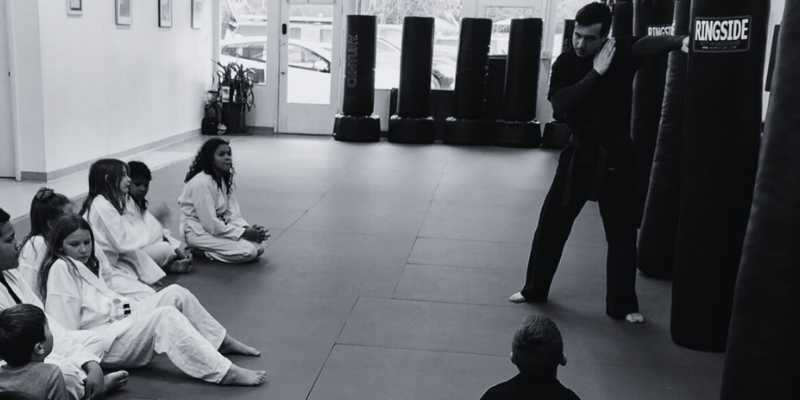
Class is one of the few settings where a child is expected to manage themselves without a parent standing next to them — lining up, following instructions, correcting their own mistakes, and trying a drill again after it didn't go well the first time. That expected self-management is deliberate, not incidental, and it's a rep parents can't easily replicate at home.
Belt progression works the same way: it hands students a defined goal and lets them own the path to it, with individualized instruction from coaches trained through the Kovar Systems curriculum and continuing education adjusting the challenge to what each student can currently handle. Older students in Dragons (ages 9–12) and teens on the adult schedule are also given leadership opportunities — helping a newer student, leading part of a warm-up — that hand over real responsibility in a supported setting.
Consistent expectations held the same way every class, alongside supportive accountability from a coach rather than a parent, give children practice at the exact skill this guide describes: doing something themselves, with support available but not applied automatically.
Independence at school specifically
Teachers generally welcome parents handing more responsibility to their child over the school year — managing their own supplies, tracking their own assignments, advocating for themselves with a question in class. A quick conversation with the teacher about what's reasonable to expect at your child's grade level can help calibrate how much to hand over and when.
Common questions
Parent Pro Tip
Protect the transition, not just the task. Most homework battles are actually transition battles. A ten-minute buffer with food and movement between school and the table removes more friction than any new reward chart.
- Snack, water, and ten minutes of moving before anything academic.
- Same place, same time, every day — the routine does the arguing for you.
- Stop at the agreed time even if it is unfinished. Consistency is the point.
From the Elevate Martial Arts coaching staff — general guidance, not professional advice.
About the author
Elevate Martial Arts Instructional Team
Coaches, Middletown & Clearlake
Our coaching staff has taught children, teens and adults in Lake County for more than 20 years. Guides in the Learning Center are written from what we see in class each week and reviewed by the instructional team before publishing. They are general educational information, not medical, psychological or legal advice.
About this guide
- Written from how Elevate structures its curriculum, coaching and classroom routines in Middletown and Clearlake.
- General educational information for families. No external research is cited and no outcome is promised.
- Reviewed by the Elevate Martial Arts instructional team.
- General educational information only — not medical, psychological or legal advice.