
Key takeaways
- Two classes a week is the standard starting point for new students of any age.
- Skills carry between sessions at twice a week; at once a week more time is spent re-learning.
- Add classes when the current schedule is comfortably repeatable — not before.
Why two
Two classes a week is close to the minimum where material sticks. A student learns something on Tuesday, sleeps on it, and revisits it Thursday while it is still partly there. That second exposure is where a skill moves from 'watched it' to 'can do a rough version of it'.
At one class a week, a meaningful share of each session goes into rebuilding what faded. Progress still happens — it is simply slower, and slower progress is harder to stay motivated through.
At four or five classes a week, a beginner is usually taking on more than their body and their calendar have adapted to. That is a schedule to grow into, not to start with.
Consistency beats volume
Almost everything families hope martial arts will support — persistence, confidence from small wins, physical skill, comfort in a group — comes from repetition across months. None of it comes from an intense fortnight.
A student attending twice a week for a year has around a hundred sessions behind them. A student who starts at four a week, burns out in six weeks and stops has twenty-four. The first student is in a different place entirely, and they had an easier year doing it.
The practical version: pick the two class times you could still make during a bad week. Same days each week, so it becomes part of the routine rather than a decision to re-argue every time.
For children
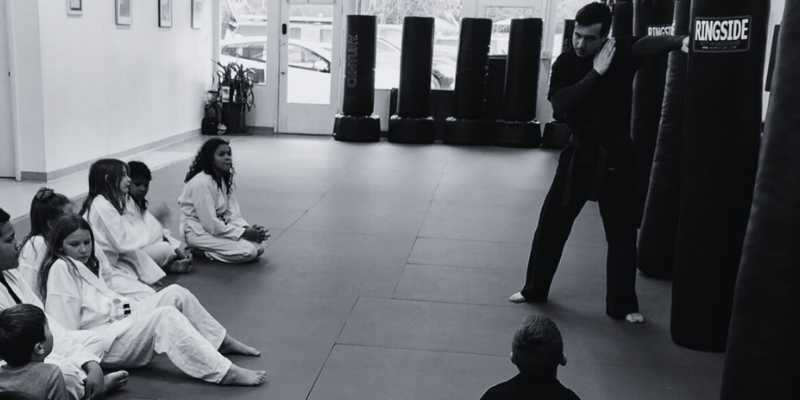
Two classes a week fits most young students alongside school, homework and everything else. Fixed days help more than anything: a child who knows Tuesday and Thursday are mat days stops negotiating about it.
During exam weeks, sports seasons or a rough patch at home, dropping to one class is much better than pausing entirely. Returning after a long gap is harder than most families expect — not physically, socially.
For adults and teens
The same rule applies, with one extra consideration: class length varies by discipline. BJJ runs 90 minutes while kickboxing and MMA run 45, so two BJJ classes is a meaningfully bigger weekly commitment than two kickboxing classes.
Adults who choose an ambitious schedule tend to miss it, feel behind, and then attend less than the adults who started conservatively and built up.
When students naturally add classes
This happens on its own, and it is one of the more satisfying things to watch. Somewhere in the first year, training stops being an activity the family signed up for and becomes the student's own thing. They start asking whether they can come on Saturday. They notice which classes cover the part they like.
That is the right moment to add, and the request should come from them. Adding classes to accelerate a child who has not asked for it tends to produce the opposite of enthusiasm.
- Both weekly classes have been attended for six to eight consecutive weeks
- The student is asking to come more, rather than being asked
- Recovery between sessions is comfortable
- The current two days are settled and no longer renegotiated
There is no pressure either way. Plenty of students train twice a week for years and get everything they came for.
Building the week
Look at the schedule for your location and pick two class times with a day between them where possible — Tuesday and Thursday, or Monday and Wednesday. A gap allows the material to settle and the body to recover.
If your week is unpredictable, tell us. Between Middletown and Clearlake there is usually a workable combination, and a coach can help you build one.
Common questions
Parent Pro Tip
The coach matters more than the style for the first two years. Almost every beginner question — will they stick with it, will they feel safe, will they be corrected kindly — is answered by the person on the floor, not by the name above the door.
- Ask how instructors are trained and supervised.
- Watch how a mistake is handled, not how a black belt performs.
- Choose the schedule you can actually make twice a week.
From the Elevate Martial Arts coaching staff — general guidance, not professional advice.
About the author
Elevate Martial Arts Instructional Team
Coaches, Middletown & Clearlake
Our coaching staff has taught children, teens and adults in Lake County for more than 20 years. Guides in the Learning Center are written from what we see in class each week and reviewed by the instructional team before publishing. They are general educational information, not medical, psychological or legal advice.
About this guide
- Written from how Elevate structures its curriculum, coaching and safety practices in Middletown and Clearlake.
- General educational information for families. No external research is cited and no outcome is promised.
- Reviewed by the Elevate Martial Arts instructional team.
- General educational information only — not medical, psychological or legal advice.