Key takeaways
- A blended curriculum rotates through striking, grappling, self-defense and character work instead of teaching one style only.
- Breadth suits beginners: children discover what they enjoy before committing to a specialty.
- Every discipline is taught in its own right — blending is about sequencing, not diluting.
What 'blended' actually means
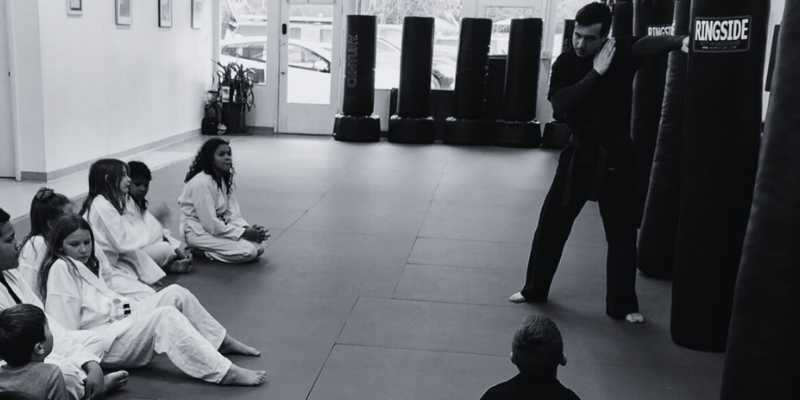
A blended curriculum is a planned rotation. Instead of spending every class of every year on one style, students move through defined blocks of material — a stretch of striking, a stretch of grappling, a stretch of self-defense — with coordination, fitness and character work threaded through all of it.
The rotation is not random. Each block has its own progression, and the blocks are ordered so skills reinforce each other: balance and stance work from striking makes grappling easier to learn, and the body awareness from grappling makes striking mechanics click faster.
- Striking and kicking — distance, timing, stance and controlled contact
- Grappling — leverage, position, falling safely and working with a partner
- Self-defense — awareness, avoidance, voice, and simple physical options last
- Coordination and fitness — the athletic base everything else sits on
- Leadership and character development — effort, respect, focus and helping newer students
Why breadth suits beginners
Very few children can tell you in advance whether they will love throwing a jab or love figuring out a position on the ground. Asking a family to pick a style before their child has tried any is asking them to guess.
Breadth also spreads out the hard parts. Every discipline has a phase that feels awkward. When a student hits that phase in one area, the rotation moves on before frustration hardens into 'I'm not good at this,' and they come back to it later with more athletic vocabulary.
None of this is a comment on single-style schools. A dedicated program in one art is an excellent path, and many of our students eventually go deep in one discipline. For a beginner — especially a child — starting wide simply gives more information.
Blended is not watered down
The reasonable worry is that teaching several things means teaching none of them well. That risk is real, and it is handled through structure rather than good intentions.
Each discipline in the rotation has its own curriculum, its own progression of skills and its own standards for what a student should be able to do before moving on. Coaches teach the material as that discipline teaches it. What changes is the calendar, not the depth of any single lesson.
Adults and teens on the adult schedule can also train a single track — kickboxing, MMA or BJJ — if they already know what they want.
What happens when a student wants to specialize
Plenty do. A student spends a year in the rotation, discovers that grappling is the part they think about all week, and starts adding BJJ classes on the adult schedule. That is the system working as intended: the choice is theirs, made from experience rather than a guess made on day one.
Others never specialize and stay generalists for years. Both are legitimate. The curriculum is built so neither path requires starting over.
The part that runs through everything
Leadership and character development are not a separate module bolted on at the end. They show up as how a student lines up, how they treat a partner who is struggling, whether they reset and try again after a bad rep, and whether they can help a newer student without showing off.
This is the part parents most often mention after a few months, and it is deliberately practiced rather than hoped for.
Common questions
Parent Pro Tip
The coach matters more than the style for the first two years. Almost every beginner question — will they stick with it, will they feel safe, will they be corrected kindly — is answered by the person on the floor, not by the name above the door.
- Ask how instructors are trained and supervised.
- Watch how a mistake is handled, not how a black belt performs.
- Choose the schedule you can actually make twice a week.
From the Elevate Martial Arts coaching staff — general guidance, not professional advice.
About the author
Elevate Martial Arts Instructional Team
Coaches, Middletown & Clearlake
Our coaching staff has taught children, teens and adults in Lake County for more than 20 years. Guides in the Learning Center are written from what we see in class each week and reviewed by the instructional team before publishing. They are general educational information, not medical, psychological or legal advice.
About this guide
- Written from how Elevate structures its curriculum, coaching and safety practices in Middletown and Clearlake.
- General educational information for families. No external research is cited and no outcome is promised.
- Reviewed by the Elevate Martial Arts instructional team.
- General educational information only — not medical, psychological or legal advice.