
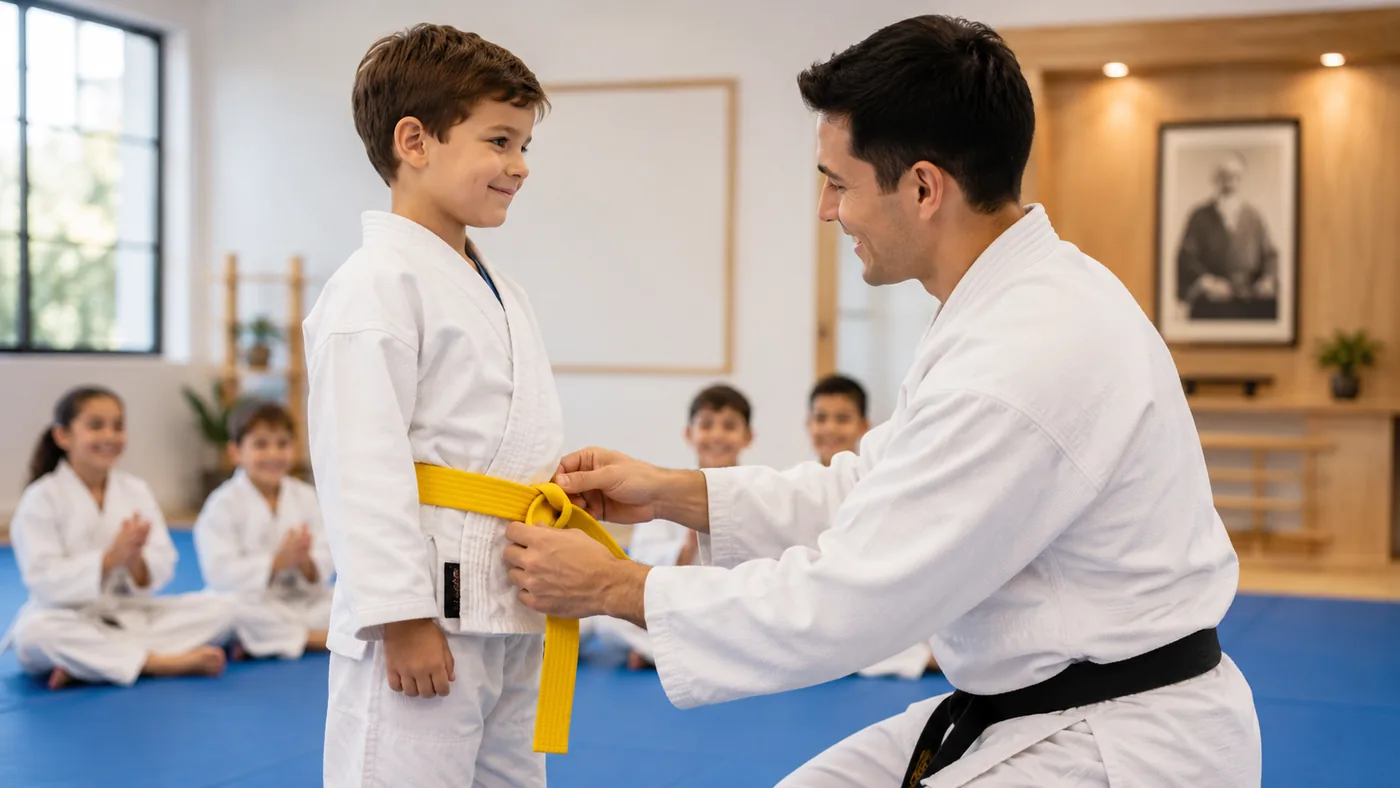
Key takeaways
- Every child begins with white belt, earned by showing they can participate with the group.
- Red and black stripes are rank stripes; blue, yellow and green stripes recognize exceptional behavior or achievement but do not count toward promotion.
- The belt is a record of effort and improvement. The goal is growth, not collecting belts.
The belt is a marker, not the goal
A belt gives a child something visible to connect to months of work, but we never want the belt itself to become the reason they train. The important things are effort, improvement, consistency and learning how to keep going when something is difficult.
When a belt changes color, it should represent those things. We would rather have a child become more focused, more responsible and more capable without worrying about the next belt than have them chase a promotion just to obtain another object.
Every child starts at white belt
White belt is the starting rank for every child at Elevate. Students earn that first belt in class by showing that they can participate with the group: listening to the coach, joining the activities and beginning to follow the class routine.
That first belt is intentionally simple. It says, in effect, 'I am part of the class, and I am ready to begin.'
Red and black stripes move the rank forward
Red and black stripes are our rank stripes. They are evaluated monthly. A child earns the next rank stripe when they are meeting the standards expected for their age and continuing to show progress.
Those standards look beyond a single good class. Attendance at the dojo matters, and so do school performance and behavior at home. The purpose is not to demand perfection. It is to help children see that martial arts growth is connected to the habits they practice throughout the rest of their week.
- Consistent attendance and participation at the dojo
- Age-appropriate progress in class
- School performance and effort
- Behavior and responsibility at home
Blue, yellow and green stripes recognize something special
Not every stripe is a rank stripe. Coaches may award blue, yellow or green stripes to recognize outstanding behavior, effort or achievement. A great report card is one example; there may be other moments when a child has done something worth celebrating.
These recognition stripes do not count toward the next belt. That is intentional. Their job is different: they give the child an outward reminder that a positive choice or accomplishment was noticed.
How many rank stripes are needed for the next belt?
The early ranks move in shorter steps. As students advance, the number of rank stripes required increases so that each new belt represents a longer period of continued work and improvement.
- White → Orange-White: after the 3rd red/black rank stripe, typically around month 3.
- Orange → Orange-Black → Yellow-White → Yellow → Yellow-Black: 3 rank stripes for each promotion.
- Purple ranks: 4 rank stripes for each promotion.
- Blue: 5 rank stripes.
- Green and Brown ranks: 6 rank stripes for each promotion.
The stripe count tells you when a student is eligible to move forward; the quality of their effort and progress is what gives the promotion meaning.
Why the requirements grow as the belts get darker
Early promotions help young students learn how the process works: show up, practice, improve, receive feedback and keep going. Later ranks ask them to sustain those habits for longer stretches.
That is part of the lesson. Progress is exciting at first because everything is new. The deeper lesson is learning to keep working after the novelty wears off. Increasing the stripe requirement gives older and more experienced students room to develop that kind of patience.
What parents can reinforce at home
The language adults use around rank makes a difference. If every conversation is about the next stripe or belt, children naturally start measuring success by what they receive. We want them measuring success by what they did.
Praise the class they attended when they were tired, the technique they kept practicing, the improved report card, the better choice at home or the moment they helped someone else. Those are the things the belt is supposed to represent.
Common questions
A better question after class
Instead of asking, 'When do you get your next belt?' try asking, 'What did you improve today?' That keeps the attention on the habits the belt is supposed to represent.
From the Elevate Martial Arts coaching staff — general guidance, not professional advice.
About the author
Elevate Martial Arts Instructional Team
Coaches, Middletown & Clearlake
Our coaching staff has taught children, teens and adults in Lake County for more than 20 years. Guides in the Learning Center are written from what we see in class each week and reviewed by the instructional team before publishing. They are general educational information, not medical, psychological or legal advice.
About this guide
- Based on Elevate Martial Arts' youth belt, stripe and instructional standards used in our kids programs.
- Reviewed by the Elevate Martial Arts instructional team.
- General educational information only — not medical, psychological or legal advice.