
Key takeaways
- Every physical activity carries risk; the meaningful comparison is between programs, not between martial arts and 'no sport'.
- Progressive instruction, close supervision and deliberate partner selection are what keep contact controlled.
- A program that teaches control before power, and rewards it, is safer than one organized around winning.
The honest answer first
Martial arts involves contact with other people, and contact carries risk. Bumps, jammed fingers, mat burns and the occasional bruise are ordinary. Anyone who tells you a contact activity is completely safe is overselling.
What is also true is that risk in youth sport varies enormously by how a program is run. Two schools teaching the same art, in the same town, can present very different levels of risk depending on supervision, progression and culture. That is the variable parents can actually assess.
How the risk compares to other youth sports
Parents usually want a comparison, and it is a fair thing to want. In broad terms, well-run martial arts programs tend to see lower injury rates than many collision and high-contact team sports, where full-speed impacts between players are part of ordinary play rather than something a coach controls.
The structural reason is straightforward. In a soccer match or a football game, contact happens at competitive speed, between players who did not plan it, in a situation nobody is pausing. In a martial arts class, a coach chooses the drill, sets the intensity, assigns the partners, and can stop the room in a second.
This is a general pattern, not a promise about any individual child or any individual class. Injuries happen in martial arts, and there are martial arts programs run in ways that raise risk rather than lower it. We would rather you evaluate the program in front of you than take a category-wide claim on faith.
- Contact is scheduled and supervised, not incidental to open play
- Intensity is set by the coach and can be lowered mid-drill
- Students are taught how to fall before they are taught anything that involves falling
- There is no scoreboard creating pressure to go harder than the drill calls for
Safety culture is the real variable
Safety in a martial arts school is less about equipment than about what the room considers normal. In a good room, tapping out early is respected rather than mocked. Saying 'my shoulder hurts' gets a coach's attention rather than an eye-roll. Going too hard with a smaller partner is corrected immediately, every time.
You can read this culture in about ten minutes of watching. Listen to what coaches praise. If control, technique and looking after a partner get the loudest recognition, that tells you more than any policy document.
Progressive instruction: why order matters
Progression means skills are taught in an order where each one makes the next one safer. Students learn to fall before they learn to be taken down. They learn distance and stance before they learn to strike with any speed. They learn to control a position before they learn anything that requires that control.
Programs that skip ahead — running before walking because it looks more impressive — create most of the avoidable injuries. The unglamorous early material is the safety system.
Partner selection and supervision
Who your child works with matters as much as what they practice. Coaches assign partners deliberately, accounting for size, experience, temperament and what the drill is asking for. A first-week student is not put opposite someone who has been training for four years and likes to test people.
Supervision means an adult who is actually watching, positioned to intervene, and willing to stop a pair mid-drill and reset them. Class sizes and coach-to-student ratios exist for exactly this reason.
If your child has an injury, a medical condition or a physical limitation, tell the coach before class. We follow your family's medical guidance; we do not give medical advice.
Learning control, not learning to win
The single biggest safety factor in a youth martial arts class is what the class is organized around. When the goal is winning an exchange, students find the fastest way to win, and speed is where injuries live. When the goal is executing a technique with control, students slow down to do it correctly, because that is what gets recognized.
Control is a taught skill. Students practice striking a pad at defined levels of power, practice stopping a technique before the point where it would cause pain, and practice easing off the moment a partner signals. Children who learn control on the mat also tend to carry a clearer sense of what force is for — one reason schools rarely see trained students starting fights.
How this looks at Elevate
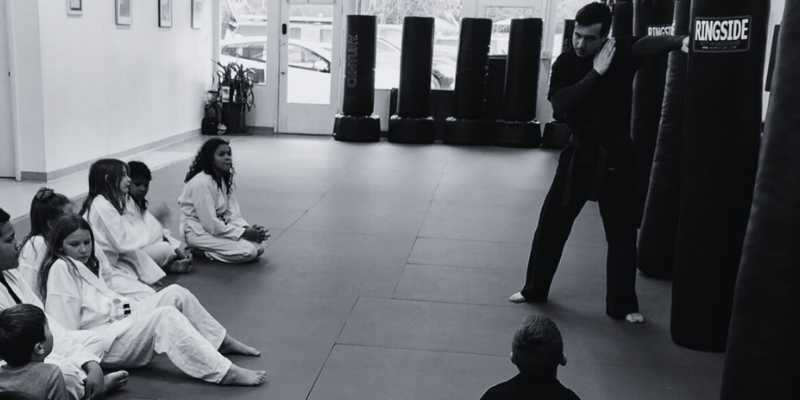
Classes are grouped by age and stage so the students in a room are working at compatible sizes and levels. Coaches assign partners, set intensity for each drill, and hold the same standard for control regardless of how advanced a student is. Falling and safe partner work are taught early rather than assumed.
You can watch any class before you enroll, and we would encourage it. Watch how a coach handles the moment when one student gets carried away — that moment tells you nearly everything.
Questions worth asking any school
Bring these to whichever schools you are considering, ours included. A program that runs safely will have ready answers.
- How are partners chosen, and how are size and experience differences handled?
- How many coaches are on the mat, and how many students?
- What is taught in the first month before any contact drills?
- How does the school handle a student who trains too hard?
- What should we do if our child has an existing injury or condition?
Common questions
Parent Pro Tip
The coach matters more than the style for the first two years. Almost every beginner question — will they stick with it, will they feel safe, will they be corrected kindly — is answered by the person on the floor, not by the name above the door.
- Ask how instructors are trained and supervised.
- Watch how a mistake is handled, not how a black belt performs.
- Choose the schedule you can actually make twice a week.
From the Elevate Martial Arts coaching staff — general guidance, not professional advice.
About the author
Elevate Martial Arts Instructional Team
Coaches, Middletown & Clearlake
Our coaching staff has taught children, teens and adults in Lake County for more than 20 years. Guides in the Learning Center are written from what we see in class each week and reviewed by the instructional team before publishing. They are general educational information, not medical, psychological or legal advice.
About this guide
- Written from Elevate's own safety practices — progression, supervision, partner assignment and intensity control — in Middletown and Clearlake classes.
- Comparisons to other youth sports describe general patterns in how contact is structured, not cited injury statistics. This is educational information, not medical advice.
- Reviewed by the Elevate Martial Arts instructional team.
- General educational information only — not medical, psychological or legal advice.