
Key takeaways
- The class format asks for participation, not performance.
- Predictable structure lowers anxiety about what happens next.
- Progress is measured against the student's own last attempt.
- Shyness is a warm-up speed, not a deficit — structure and repetition do most of the work.
- Expect four to six weeks before social change is visible.
Why the format helps
Every class follows the same shape: line up, warm up, drill, partner work, close. A shy child knows what is coming, which removes most of the uncertainty that makes new settings hard.
Partner work also means the social unit is two people, not twenty. That is a much easier room to be in.
Parent Pro Tip
Structure is what shy children are usually missing, not courage. When a child knows exactly what happens next and what is expected of them, most of the anxiety has nowhere to attach.
What the first class looks like
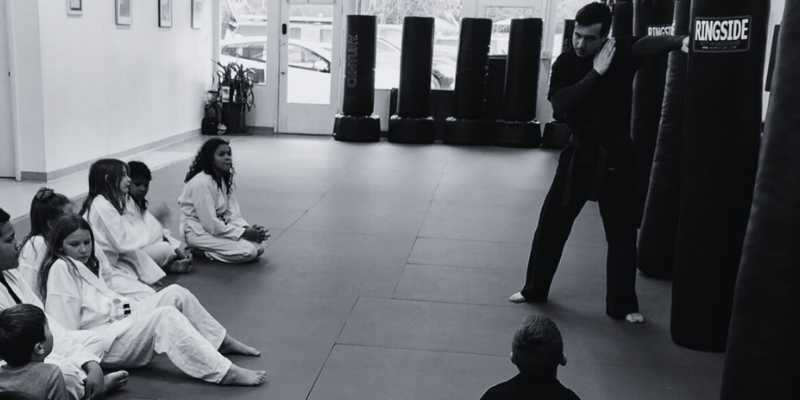
New students are introduced quietly, paired with an experienced partner, and never asked to demonstrate in front of the group on day one. Watching from the side for a class first is always allowed.
Honest caveats
Martial arts will not make a quiet child outgoing, and it should not try to. What many families notice is a child who is more comfortable being seen — which is a different and more useful thing.
Parent Pro Tip
A shy child will often not speak to anyone for the first three or four weeks. That is a normal timeline, not a sign it is going badly.
No activity guarantees a change in temperament. For concerns about anxiety, speak to a qualified professional.
Shyness and anxiety are not the same thing
It is worth separating these, because they need different things. Shyness is a temperament — a slower warm-up around new people, which is common, stable and not a problem to be solved. Anxiety is distress: physical symptoms, avoidance that expands over time, sleep affected, worry that persists once the situation has passed.
A shy child usually settles once the setting becomes familiar, and a well-structured class speeds that up. A child with significant anxiety may need something more than a good class, and pushing them into a group setting without support can entrench the avoidance. If you are seeing stomach aches on class days that continue for weeks, escalating refusal, or worry that is spreading into other parts of life, that is a conversation for your pediatrician rather than a coaching problem.
This guide is general educational information and is not a diagnostic tool. Persistent distress is worth raising with a qualified professional.
Why a structured class suits a slow-to-warm child
Most social settings a shy child encounters are unstructured, and unstructured is the hard mode. A playground requires you to invent an approach, read a group and risk rejection, all without a script. A structured class removes almost all of that: the order of the session is fixed, the coach assigns partners, and there is always an obvious thing to be doing with your hands.
Add repetition and the picture improves further. The same faces, the same room, the same opening routine each week means a child spends their limited social energy on people rather than on figuring out the environment. By the fourth or fifth session, they are not meeting anyone new — they are just showing up.
None of this is unique to martial arts. Any activity with a fixed structure, assigned partners and a stable group offers the same thing. Martial arts tends to be a reasonable fit because participation does not require speaking, which removes the exact barrier that stops many shy children in a drama group or a discussion-based club.
- The session order is predictable, so there is nothing to work out on arrival.
- Partners are assigned by the coach rather than chosen socially.
- Progress is individual, so no one is waiting on your child to perform.
- You can participate fully without saying much at all.
A realistic eight weeks
Setting expectations correctly prevents a lot of premature quitting. The pattern below is close to what we see with genuinely shy children, and knowing it in advance stops week three from feeling like a verdict.
- Weeks 1–2: watching more than doing, standing at the back, minimal speech. Normal.
- Weeks 3–4: joining in physically, still not initiating socially. Often the lowest-motivation point.
- Weeks 5–6: knows a couple of names, has a preferred spot in the room, complains less about going.
- Weeks 7–8: speaks to at least one peer unprompted, and this is usually when parents notice something has shifted.
Parent Pro Tip
Do not ask "did you have fun?" on the drive home in week two. Ask what they worked on. The first question invites a verdict a shy child is not ready to give.
What helps, and what backfires
The most common well-meant mistake is narrating the shyness in front of the child — "she's shy, she won't talk to you" — which hands them an identity and an excuse in the same sentence. Coaches hear this at the door constantly, and the children who are described that way tend to live up to it for longer.
The second is over-rewarding participation, which raises the stakes. A child who gets a big celebration for speaking to one person now has something to lose next week.
- Do brief the coach privately about what helps; do not brief them in front of your child.
- Do stay for the first few sessions if that is allowed, and then start leaving.
- Do not offer rewards for talking to people — it turns a social step into a performance.
- Do let partial participation count. Standing at the edge is attending.
Common questions
Parent Pro Tip
Let a shy child arrive early rather than on time. Walking into a half-empty room and watching it fill up is a completely different experience from walking into a full one with everyone already looking at the door. It costs you ten minutes and removes the single hardest moment of the session.
- Arrive early for the first month, every time.
- Tell the coach in advance what helps — one sentence is enough.
- Let them watch from the edge in week one if they need to; that counts as attending.
From the Elevate Martial Arts coaching staff — general guidance, not professional advice.
Where to read more
- CASELThe five areas of social and emotional learning: self-awareness, self-management, social awareness, relationship skills and responsible decision-making
- Centers for Disease Control and PreventionPlain-language background on children's mental health and when to seek support
- Harvard Center on the Developing ChildWhy at least one stable, supportive adult relationship is the most common factor in children who do well after hardship
About the author
Elevate Martial Arts Instructional Team
Coaches, Middletown & Clearlake
Our coaching staff has taught children, teens and adults in Lake County for more than 20 years. Guides in the Learning Center are written from what we see in class each week and reviewed by the instructional team before publishing. They are general educational information, not medical, psychological or legal advice.
About this guide
- Written from what Elevate coaches see week to week in Middletown and Clearlake classes.
- General educational information for families. No external research is cited and no outcome is promised.
- Where this guide points to public health or education guidance, the organisation is named and linked so you can read the original.
- Reviewed by the Elevate Martial Arts instructional team.
- General educational information only — not medical, psychological or legal advice.