
Key takeaways
- Confidence is task-specific and comes from evidence; self-esteem is broader and comes from belonging.
- A child can be highly capable and still feel their worth depends on performing.
- Constant comparison tends to erode both at once.
The distinction, in one paragraph
Confidence answers a question about a task: can I do this thing? It grows from proof, which is why reassurance rarely produces much of it. Self-esteem answers a question about the person: am I still fine if this goes badly? It grows from how a child is treated when things do go badly.
The two often move together but not always, and the mismatch is worth watching for. A child who wins constantly and falls apart at one loss usually has plenty of the first and less of the second.
Confidence comes from competence and visible progress
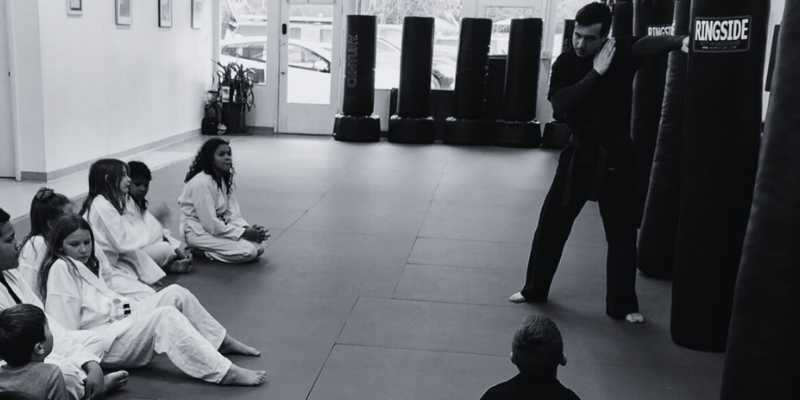
The reliable route is unglamorous: a skill just beyond current ability, enough attempts to get it, and a marker showing the change. In class that might be holding a stance longer than last month, remembering a sequence unprompted or working with a bigger partner without backing off.
This is why we point at specifics rather than offering general praise. "You held that position the whole round" is evidence a child can carry. "You're amazing" is a nice thing to hear and disappears immediately.
- A challenge slightly above current ability
- Enough repetitions for the skill to become reliable
- A visible marker of the change over weeks, not days
- Specific feedback the child can repeat back to you
Self-esteem is supported by belonging and respectful correction
Children read their standing in a room quickly. Whether they are greeted by name, whether correction is delivered without humiliation, whether they have a role when they are not the strongest person present — those details do more for self-esteem than any pep talk.
Contribution matters too. Holding a pad well, helping a newer student find the line, resetting the equipment: small responsibilities give a child a reason to be there that does not depend on being the best.
A child should not have to be the best in the room to know they belong in the room.
Why constant comparison damages both
Ranking is unavoidable in any group activity, and children do it without adult help. The problem starts when the ranking becomes the story of the class. Confidence suffers because progress is measured against a moving target, and self-esteem suffers because belonging appears conditional.
In practice, coaches at our Middletown and Clearlake classes recognize effort, responsibility and improvement alongside skill. That is not a way of avoiding standards; it is a way of making sure the students who are improving fastest from where they started are visible too.
Common questions
Parent Pro Tip
Confidence is downstream of competence. Children rarely talk themselves into believing they can do something; they collect evidence. Your job is not to convince them — it is to keep arranging small, honest, slightly-hard reps and then point out what they just did.
- Choose challenges your child can complete in about eight out of ten attempts.
- Describe the effort and the specific action, not the identity: "you kept your hands up", not "you're a natural".
- Let them fail small and often, in places where failure is cheap.
From the Elevate Martial Arts coaching staff — general guidance, not professional advice.
About the author
Elevate Martial Arts Instructional Team
Coaches, Middletown & Clearlake
Our coaching staff has taught children, teens and adults in Lake County for more than 20 years. Guides in the Learning Center are written from what we see in class each week and reviewed by the instructional team before publishing. They are general educational information, not medical, psychological or legal advice.
About this guide
- Written from what Elevate coaches see week to week in Middletown and Clearlake classes.
- General educational information for families. No external research is cited and no outcome is promised.
- Reviewed by the Elevate Martial Arts instructional team.
- General educational information only — not medical, psychological or legal advice.