
Key takeaways
- Predictability, visual demonstration, repetition and small steps are what make an activity workable for many autistic children.
- The sensory environment — noise, lighting, crowding, transitions — often matters more than the activity itself.
- Group classes and private lessons are both legitimate starting points; many families use private lessons first and move into groups later.
What this guide is and is not
This is general information for families choosing activities. It is written by coaches, not clinicians.
Martial arts is not a treatment or therapy. Elevate does not diagnose or treat autism, ADHD or any other medical or developmental condition, and nothing here replaces guidance from your child's doctor or care team.
Autistic children differ enormously from one another. Nothing below applies to every child, and you know yours better than any guide does.
What tends to make an activity accessible
Across very different activities, the features that help are remarkably consistent. When families tell us an activity worked, these are usually the reasons.
- A predictable routine — the same opening, the same order, the same closing, every session.
- Visual demonstration — showing the movement rather than describing it in a paragraph of words.
- Repetition — the same skill practiced many times, with mastery expected slowly.
- Small achievable steps — a skill broken down far enough that success comes early and often.
- Individualized coaching — an instructor who adapts pace, contact and language to the child in front of them.
- A manageable sensory environment — predictable noise levels, no sudden whistles, clear physical boundaries.
- Few unstructured transitions, which are often the hardest part of any session.
Local options to consider
Lake County is small, and options are fewer than in a city — but several are genuinely workable, and the county's outdoor space is an advantage for children who find indoor group settings overwhelming.
- Swimming — individual, sensory-rich in a way many children find regulating, and a genuine safety skill near the lake.
- Trails and outdoor recreation — low social demand, high movement, easy to keep short.
- Library programs — short, quiet and free, and a low-stakes way to test group tolerance.
- Structured indoor classes such as martial arts — predictable format, visual teaching and clear expectations.
- Ask your school team or local family resource contacts about current supports; availability changes and they will know what is running now.
Contact any program before the first visit and ask what a session actually looks and sounds like. Good programs will happily tell you, and will let you watch first.
Why structured martial arts classes suit many students
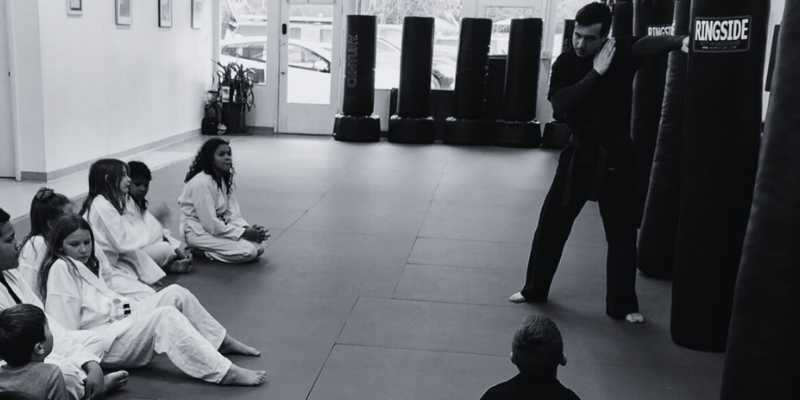
A martial arts class is built around exactly the features listed above, not because it was designed for neurodiverse learners but because that is how physical skills are taught well. Class opens the same way each time. Skills are shown before they are described. Everything is repeated. Progress is broken into small, named steps, and a student is measured against their own last attempt rather than the class.
The physical structure helps too: defined spots on the mat, clear expectations for where to stand and what to do, and short instructions rather than long explanations. For a child who struggles with open-ended situations, that clarity can be a relief.
We are careful not to overclaim. Some children thrive in this setting, some need a different one, and some need time before a group class is right. What we can say is that many children with ASD and ADHD participate successfully in structured environments like these, and that we teach to the individual child rather than a one-size-fits-all script.
Group classes and private lessons
Elevate offers both, and the choice is practical rather than hierarchical. Private lessons give a quiet room, one coach, and a pace set entirely by the student — useful for building comfort with the format, the coach and the physical contact involved in partner work.
Group classes add the social element: waiting for a turn, working with a partner, being part of a room. That is often the thing families most want, and it is easier to reach after some individual groundwork.
A common path is a short run of private lessons, then a group class alongside them, then group classes alone. There is no set timeline and no pressure to move faster than the student is ready for.
Making a first visit go well
Tell us in advance what helps and what does not. Sensory triggers, communication preferences, how your child responds to physical contact, what a hard moment looks like and what you would like us to do when it happens. None of that is an imposition — it is the information we need to coach well.
Then keep the first visit small. Watching a class from the side is a legitimate first session. So is stepping on the mat for ten minutes and leaving. Starting below capacity almost always beats starting above it.
Common questions
Parent Pro Tip
Ask what happens on a hard day. Every program is inclusive on a good day. The useful question is what a coach does when a child needs to sit out, cover their ears, leave the mat or come back in halfway through — and whether that plan already exists before you arrive.
- Share what helps your child before the first class, in writing.
- Agree on a specific exit-and-return plan with the coach.
- Treat partial participation in week one as a genuine success.
From the Elevate Martial Arts coaching staff — general guidance, not professional advice.
About the author
Elevate Martial Arts Instructional Team
Coaches, Middletown & Clearlake
Our coaching staff has taught children, teens and adults in Lake County for more than 20 years. Guides in the Learning Center are written from what we see in class each week and reviewed by the instructional team before publishing. They are general educational information, not medical, psychological or legal advice.
About this guide
- Written from what Elevate coaches hear from Lake County families in Middletown and Clearlake each week.
- Local organizations, parks and schools are named for orientation only. Schedules, fees and eligibility change — confirm current details directly with each organization.
- General educational information. No external research is cited and no outcome is promised.
- Written by coaches, not clinicians. Nothing here is medical, psychological or developmental advice.
- Reviewed by the Elevate Martial Arts instructional team.
- General educational information only — not medical, psychological or legal advice.