
Key takeaways
- Frustration tolerance is a skill that builds with practice, not a fixed personality trait.
- Children get frustrated fastest at tasks that sit just past their current skill level with no clear next step.
- Naming frustration out loud, without rushing to fix it, helps a child learn to sit with the feeling.
- Repeated practice at manageable challenges, with a coach nearby, builds tolerance gradually and safely.
What frustration tolerance actually is
Frustration tolerance is the ability to stay engaged with a difficult task without the feeling of difficulty tipping into anger, tears or giving up. It is not the same as being naturally calm — plenty of even-tempered children still have low frustration tolerance in specific areas, and plenty of intense children have plenty of it.
Like most skills, it develops through repeated, manageable exposure to difficulty. A child who has rarely had to sit with 'this is hard and I have not solved it yet' has had less practice at the feeling itself, regardless of how smart or capable they are.
Why some children hit frustration so quickly
Frustration usually shows up fastest in the gap between what a task demands and what a child currently has to meet it — whether that is a skill, a strategy, or simply the patience to keep trying. Shoelaces, math homework and a video game level can all trigger the same reaction if they land in that gap for a particular child.
Fatigue, hunger and an already-full emotional tank lower the threshold further. A task that would be mildly annoying on a good day can feel unbearable at the end of a long one.
- The task is genuinely too hard for the current skill level, with no visible next step
- The child has had little practice tolerating the feeling of not immediately succeeding
- Energy or emotional reserves are already low from earlier in the day
- Past experience with the same task has already gone badly, adding dread on top of difficulty
What tends to make it worse
Rushing in to fix the task the moment frustration appears feels kind but removes the practice opportunity — the child never gets the chance to sit with the discomfort and come out the other side. Minimizing it ('it's not a big deal') can leave a child feeling unseen, which often intensifies the reaction rather than calming it.
Punishing the frustration itself, rather than any actual misbehavior that came with it, also tends to backfire, since it adds shame to an already hard moment without teaching a replacement skill.
What actually helps
Naming the feeling out loud — 'this is frustrating, this part is hard' — without immediately solving it gives a child language for the experience and signals that the feeling itself is normal and survivable. From there, breaking the task into a smaller next step, rather than the whole remaining task, gives them somewhere real to put their effort.
It also helps to praise the attempt and the return to trying, not just the eventual success. Children build frustration tolerance by noticing that they can feel frustrated and keep going anyway — that pattern is what generalizes to the next hard task.
Frustration tolerance needs repeated practice
Because it is a skill, frustration tolerance grows fastest with regular, low-stakes practice rather than occasional high-stakes moments. A weekly activity that reliably includes some difficulty — a new skill that does not come immediately, a drill that takes several tries — gives a child low-pressure repetition at exactly the feeling they need more practice tolerating.
How Elevate can help
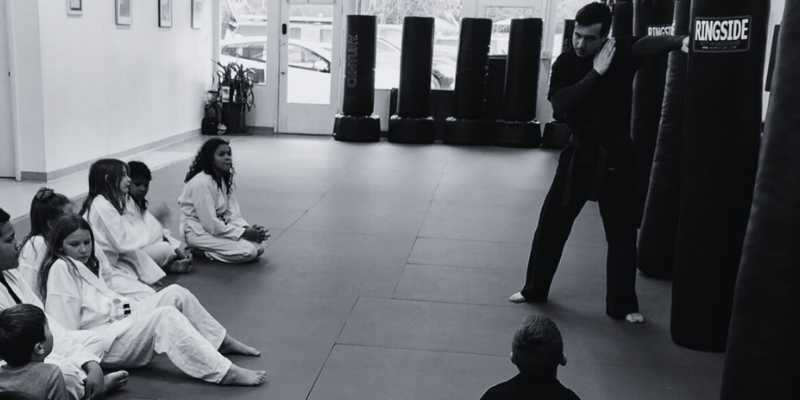
Martial arts naturally includes moments that do not go right the first time — a kick that lands off balance, a combination that takes several attempts to remember, a belt test skill that needs more repetition than expected. Structured classes give students weekly, low-stakes practice at staying with that feeling instead of walking away from it.
Coaches trained through the Kovar Systems curriculum and ongoing continuing education are specifically taught how to break a hard skill into an achievable next step for a student who is getting frustrated, and how to recognize the difference between a student who needs encouragement and one who needs the difficulty adjusted. Individualized instruction means the pace of a drill can flex to a student's current skill level rather than staying fixed.
The class structure itself supports this: Little Dragons (ages 3–4, 40 minutes) work on very short, achievable challenges; Tigers (ages 5–8) and Dragons (ages 9–12, 45 minutes) take on progressively harder material with consistent coach support; and teens and adults on the adult schedule continue building tolerance for difficulty at a more advanced level. Belt promotions are built around exactly this kind of accumulated persistence through hard material.
Common questions
Parent Pro Tip
Regulate first, teach second. A child in the middle of a big feeling cannot access the part of their brain you are trying to reason with. Coaches learn this quickly on the mat: you get the breathing back, then you correct the technique. The order matters more than the words.
- Lower your own volume before you lower theirs.
- Name what you see: "That was frustrating." Do not add "but".
- Come back to the lesson later, when the storm has passed.
From the Elevate Martial Arts coaching staff — general guidance, not professional advice.
About the author
Elevate Martial Arts Instructional Team
Coaches, Middletown & Clearlake
Our coaching staff has taught children, teens and adults in Lake County for more than 20 years. Guides in the Learning Center are written from what we see in class each week and reviewed by the instructional team before publishing. They are general educational information, not medical, psychological or legal advice.
About this guide
- Written from how Elevate structures its classes, coaching and expectations in Middletown and Clearlake.
- General educational information for families. No external research is cited and no outcome is promised.
- Reviewed by the Elevate Martial Arts instructional team.
- General educational information only — not medical, psychological or legal advice.