
Key takeaways
- Frequent low-stakes failure beats rare high-stakes failure.
- Fast retries matter — waiting a week to try again teaches less.
- How adults react to the mistake is half the lesson.
- Resilience needs challenge plus a supportive adult — challenge alone produces avoidance.
- Judge an activity by what happens in the three seconds after a mistake.
A simple test for any activity
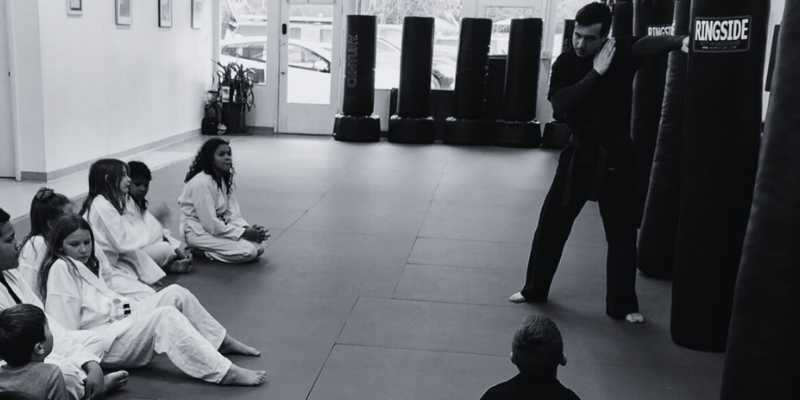
Count how many times in one session a child gets something wrong and immediately tries again. In a martial arts class that number is high and the stakes each time are low. In some activities a child might get one meaningful attempt a week.
- How often can they fail without it being a big deal?
- How quickly can they try again?
- Does an adult respond calmly and specifically?
- Is progress visible over months, not only at a final event?
Parent Pro Tip
The best single question about any activity: how often does my child get to fail here safely, and what happens immediately afterwards?
The adult response is half of it
A child watches the room after a mistake. If the coach's reaction is matter-of-fact and the correction is specific, the mistake becomes information. If the reaction is disappointment, the child learns to avoid attempts instead.
Parent Pro Tip
Children calibrate their reaction to a setback by watching yours first. Your face in the two seconds after they lose is doing more teaching than anything you say afterwards.
Backing it up at home
The car ride home is part of the activity. Asking what was hard, rather than how they did, keeps the emphasis where it helps.
Resilience develops differently for every child, and no activity guarantees it.
What resilience actually means
Resilience is not toughness and it is not the absence of distress. In the way the American Psychological Association describes it, it is the process of adapting well in the face of adversity — which means it is a set of learnable behaviours rather than a personality trait a child either has or lacks.
That distinction matters for parents, because it changes what you are shopping for. If resilience were a trait, you would be looking for an activity hard enough to forge it. Because it is a process, you are looking for an environment that provides many small setbacks, immediate support, and a reliable route back in.
The Harvard Center on the Developing Child frames the same idea as a balance: adversity on one side, supportive relationships and coping skills on the other. Load one side without the other and you do not get resilience, you get a child who avoids the situation.
- Manageable challenge, repeated — not a single dramatic hardship.
- At least one adult who responds warmly and consistently.
- A quick, low-shame route back after a mistake.
- Some sense of control: the child can affect the outcome by what they do next.
Auditing an activity in one visit
You can assess most of this from the side of one class. You are not evaluating the skill on display — you are evaluating the failure culture, because that is the part that builds anything.
- How often does a child get something wrong in a typical ten minutes? If the answer is rarely, no one is being stretched.
- What happens in the three seconds after a mistake — correction, silence, laughter, or nothing at all?
- Does the correction come with a specific next attempt, or just a judgment?
- Are children ever left waiting long enough to disengage?
- Does anyone acknowledge the child who is furthest behind?
Parent Pro Tip
Sit where you can hear the coach rather than where you can see best. Tone carries the whole answer.
Activities that tend to do this well
Plenty of settings meet the criteria, and the right one depends on your child far more than on the category. What follows is a rough map of why each tends to work, so you can judge the specific program in front of you rather than the label.
- Individual-progression sports — martial arts, gymnastics, swimming, climbing: frequent small failures, immediate retries, progress measured against yourself.
- Team sports: shared setbacks and social recovery, though individual reps can be scarcer on a big roster.
- Music and performing arts: high repetition, visible progress, and one very public failure point in a recital.
- Outdoor and adventure activities: real consequences and problem-solving, usually less frequent.
- Chess, robotics and debate: fast loss-and-restart cycles with no physical element.
There is no ranking here. A warm coach in a mediocre program will build more resilience than a dismissive one in an excellent program.
The half that happens at home
Whatever the activity provides, the debrief belongs to you, and it is easy to get wrong in either direction. Rushing to fix the feeling — "it doesn't matter, you were great" — tells a child their reaction was wrong. Piling on analysis tells them the setback was significant enough to warrant a review.
The middle path is short and unremarkable: name the feeling, resist the fix, and let the next session be the answer. Most of the learning happens in the returning, not in the conversation about it.
- "That was frustrating." Then stop talking for a bit.
- Do not ask what went wrong in the car. Ask on the way to the next session.
- Do not skip the following session to protect them from the feeling.
- Tell them about something you were bad at for a long time — accurately.
Common questions
Parent Pro Tip
Resilience is not built by hardship. It is built by hardship plus a supportive adult. The Harvard Center on the Developing Child keeps arriving at the same conclusion — the most common factor in children who cope well is at least one stable, responsive relationship. So when you are choosing an activity, you are mostly choosing an adult.
- Watch how the coach responds to a child who is struggling, not a child who is excelling.
- Ask whether the same instructor teaches the class every week.
- Prefer a warm coach with an ordinary program over a brilliant program with a cold one.
From the Elevate Martial Arts coaching staff — general guidance, not professional advice.
Where to read more
- American Psychological AssociationHow resilience is built through relationships, routines and manageable challenge
- Harvard Center on the Developing ChildWhy at least one stable, supportive adult relationship is the most common factor in children who do well after hardship
- CASELThe five areas of social and emotional learning: self-awareness, self-management, social awareness, relationship skills and responsible decision-making
About the author
Elevate Martial Arts Instructional Team
Coaches, Middletown & Clearlake
Our coaching staff has taught children, teens and adults in Lake County for more than 20 years. Guides in the Learning Center are written from what we see in class each week and reviewed by the instructional team before publishing. They are general educational information, not medical, psychological or legal advice.
About this guide
- Written from what Elevate coaches see week to week in Middletown and Clearlake classes.
- General educational information for families. No external research is cited and no outcome is promised.
- Where this guide points to public health or education guidance, the organisation is named and linked so you can read the original.
- Reviewed by the Elevate Martial Arts instructional team.
- General educational information only — not medical, psychological or legal advice.