
Key takeaways
- A child who refuses to start is often protecting themselves from an imperfect attempt.
- The target is tolerance for being unfinished, not a lower standard.
- Fast, low-stakes retries build that tolerance faster than any conversation about it.
Separate getting it wrong from being wrong
Perfectionist children tend to collapse those two ideas together, so every correction becomes evidence about their worth. The separation has to be demonstrated repeatedly rather than explained once, and the demonstration is mostly in tone and pace: correction given matter-of-factly, immediately followed by another go.
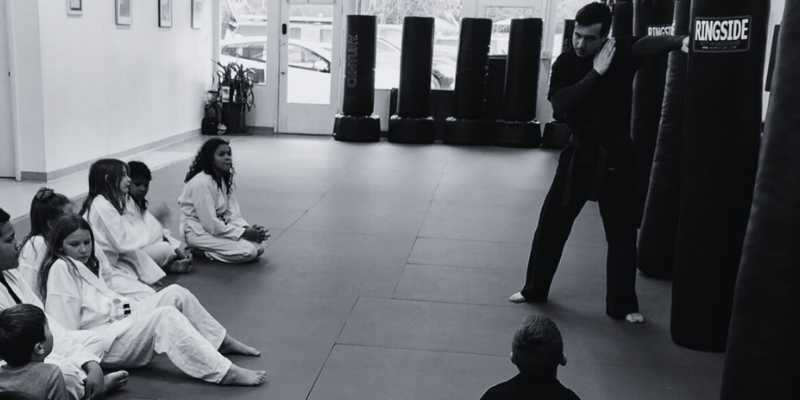
Coaches also make their own errors visible on purpose. A student who watches an adult miss a technique, shrug, and try it again has seen something more convincing than a speech about mistakes being okay.
We do not wait for confidence before asking for effort. Confidence is often what follows the effort.
Controlled imperfect repetitions and fast retries
The most direct practice is a high number of low-stakes attempts, done fast enough that no single one carries much weight. When ten repetitions are expected, the third one being poor is unremarkable. When a child believes there is only one attempt, every attempt is an exam.
Coaches manage the difficulty so the student is working at a level where imperfection is normal but progress is still visible. That is a narrow band, and it is one of the main things an experienced instructor is doing while a class looks simple from the sidelines.
- Many quick attempts instead of one careful one
- A retry within seconds of a mistake, before frustration settles
- Difficulty set so the student succeeds partially, not completely
- Recognition for the retry itself, not only for the clean repetition
Parent language that does not turn practice into an evaluation
Perfectionist children are unusually good at detecting evaluation. Questions like "were you the best one?" or "did the coach say you did well?" quietly confirm that performance is what is being measured, even when that is not what you meant.
Ask about the work instead. What did you practice? Which part is hard right now? What are you doing again next week? Those questions describe training as an ongoing process rather than a series of graded events.
Perfectionism that comes with persistent anxiety, sleep problems, physical symptoms or real distress deserves support from a qualified professional. A martial arts class is a helpful practice environment, not a treatment, and coaches will tell you plainly when something is outside what training can address.
Common questions
Parent Pro Tip
Confidence is downstream of competence. Children rarely talk themselves into believing they can do something; they collect evidence. Your job is not to convince them — it is to keep arranging small, honest, slightly-hard reps and then point out what they just did.
- Choose challenges your child can complete in about eight out of ten attempts.
- Describe the effort and the specific action, not the identity: "you kept your hands up", not "you're a natural".
- Let them fail small and often, in places where failure is cheap.
From the Elevate Martial Arts coaching staff — general guidance, not professional advice.
About the author
Elevate Martial Arts Instructional Team
Coaches, Middletown & Clearlake
Our coaching staff has taught children, teens and adults in Lake County for more than 20 years. Guides in the Learning Center are written from what we see in class each week and reviewed by the instructional team before publishing. They are general educational information, not medical, psychological or legal advice.
About this guide
- Written from what Elevate coaches see week to week in Middletown and Clearlake classes.
- General educational information for families. No external research is cited and no outcome is promised.
- Reviewed by the Elevate Martial Arts instructional team.
- General educational information only — not medical, psychological or legal advice.