
Key takeaways
- Losing gracefully is practiced, not lectured into place.
- Frequent small losses defuse the stakes.
- Separate the loss from the effort when you talk about it.
- Separate the feeling, which is allowed, from the behaviour, which is coachable.
- Many small losses teach this; a few big ones rarely do.
Repetitions, not lectures
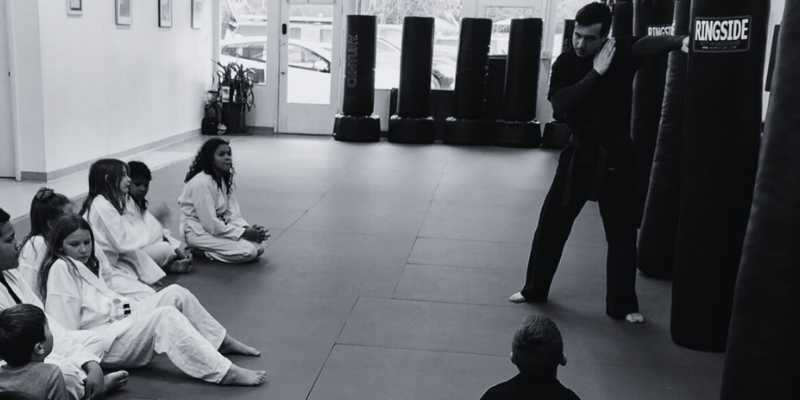
In a partner drill a child might come off worse a dozen times in one class, shake hands and go again. That volume does something no conversation can: it makes losing ordinary.
Parent Pro Tip
A child needs dozens of small losses to learn this, which means an activity where losing happens once a season is a poor teacher regardless of its quality.
Helping a child reset
The goal is a shorter recovery, not a child who never minds. Most students go from a ten-minute sulk to a ten-second one over a few months.
- Acknowledge the feeling briefly, then move to the next round
- Ask what they will try differently rather than what went wrong
- Keep your own reaction flat — children mirror it
- Notice out loud when they recover quickly
Parent Pro Tip
Give them somewhere to go. A designated spot on the edge of the mat is far better than "calm down", because it is a thing they can actually do with their body.
Does competition help?
For some students, yes. For others it raises the stakes before they are ready. Competing at Elevate is entirely optional and never a requirement for progression.
Why losing is genuinely hard at this age
Big reactions to losing are not usually a character problem. They are a self-regulation problem, and self-regulation is a skill that develops over roughly two decades. The part of the brain that manages impulse and perspective is still under construction well into the twenties, which is why a child who genuinely understands sportsmanship in the abstract can still throw a controller.
There is often a second layer underneath. For many children, losing is not about the game — it is a data point about whether they are good enough. A child who has quietly decided that their worth is tied to performance is not upset about a point; they are upset about what the point means. Those children need the meaning changed before the behaviour will move.
Emotion coaching in four steps
The most reliable approach we see — consistent with how social and emotional learning frameworks like CASEL describe self-management — is to treat the feeling as legitimate and the behaviour as coachable. Those are two separate conversations and they should not happen at the same time.
- Notice it early, before the peak. The moment to intervene is when the jaw sets, not after the throw.
- Name it plainly: "you really wanted that one". Do not add a lesson to the end of the sentence.
- Set the limit on behaviour only: "you can be furious. You can't throw the pads."
- Solve it later, together: "next time, what's the plan for the ten seconds after you lose?"
Parent Pro Tip
The gap between step three and step four should be at least twenty minutes. Almost every parent tries to compress them into one conversation and the lesson does not land.
Why frequency matters more than the sport
A child who plays one team sport might genuinely lose four or five times a season. That is not enough repetition to build a habit. Settings with high loss frequency — sparring, rolling, chess, individual matches, or simply playing cards at home — give a child dozens of small, low-stakes losses in a month.
This is a real advantage of grappling and sparring formats specifically, and it is worth naming plainly rather than romanticising. In a jiu-jitsu round a child might lose a position twenty times in six minutes. The stakes on each one are tiny, the recovery is immediate, and nobody in the room treats it as significant. That is close to ideal conditions for learning to lose, and it is the reason coaches often see the biggest change in this area from students who train regularly rather than occasionally.
You can create the same conditions at home with a deck of cards and ten minutes. The mechanism is frequency and low stakes, not the activity.
The part parents accidentally teach
Children learn most of their loss behaviour by watching adults, and the tells are small. The sigh on the drive home. The instant analysis of what the referee got wrong. The way a parent's mood tracks the result. None of these are said out loud, and all of them are received.
The most useful thing you can model is a flat, uninteresting response to results in either direction. When winning and losing produce roughly the same reaction from you, the result stops being a verdict on the child, and the size of the emotion tends to come down with it.
- Ask what they worked on before you ask how it went.
- React the same way to a win as to a loss — briefly and warmly.
- Never critique the officiating in front of your child.
- Let them see you lose at something and shrug.
Common questions
Parent Pro Tip
Coach the reset, not the attitude. "Be a good sport" is a value; it is not an instruction a nine-year-old can follow while flooded with adrenaline. Give them a physical sequence instead — stand up, breathe out, shake hands, walk to the wall, come back — and rehearse it when they are calm. Behaviour learned as a sequence survives the moment. Behaviour learned as a lecture does not.
- Practise the reset sequence on a good day, not in the aftermath.
- Use the same words every time so it becomes automatic.
- Praise the reset out loud, and say nothing about the result.
From the Elevate Martial Arts coaching staff — general guidance, not professional advice.
Where to read more
- CASELThe five areas of social and emotional learning: self-awareness, self-management, social awareness, relationship skills and responsible decision-making
- American Psychological AssociationGuidance on helping children recognise and manage stress
- Centers for Disease Control and PreventionPositive parenting tips organised by developmental stage
About the author
Elevate Martial Arts Instructional Team
Coaches, Middletown & Clearlake
Our coaching staff has taught children, teens and adults in Lake County for more than 20 years. Guides in the Learning Center are written from what we see in class each week and reviewed by the instructional team before publishing. They are general educational information, not medical, psychological or legal advice.
About this guide
- Written from what Elevate coaches see week to week in Middletown and Clearlake classes.
- General educational information for families. No external research is cited and no outcome is promised.
- Where this guide points to public health or education guidance, the organisation is named and linked so you can read the original.
- Reviewed by the Elevate Martial Arts instructional team.
- General educational information only — not medical, psychological or legal advice.