Key takeaways
- Schedule and drive time decide consistency more than discipline choice does — pick the location you will actually reach.
- Ask how beginners are introduced to live training before you commit to anything longer than a trial.
- A trial class tells you more about a school's culture than any description, including this one.
What adults can train locally
In a rural county the range is narrower than in a metro area, but the core options for adults are here. Brazilian jiu-jitsu, kickboxing and mixed martial arts are the disciplines most commonly available to adult beginners in Lake County, generally taught in evening classes designed around people who work during the day.
Availability shifts over time as instructors move and schedules change, so it is worth checking current timetables rather than relying on anything you read once. What tends to remain stable is the shape of adult training: two or three evening options a week per discipline, mixed experience levels in the same room, and beginners joining year-round rather than in intakes.
Middletown, Clearlake and the drive
Lake County's geography is the deciding factor for many adults. The drive between the south county around Middletown and the lakeshore communities around Clearlake is significant enough that most people train wherever is closer, and that is generally the right call: the school you can reach in fifteen minutes after work will beat the better-matched school forty-five minutes away, because attendance is what produces results.
If you sit between the two, look at the actual class times rather than the distance. A 6:00 pm class you can only reach by leaving work early is worse than a 7:00 pm class further away. It is also worth checking whether a school runs the same discipline at both sites, which gives you a fallback when your usual night is impossible.
What to ask before you join
The useful questions are practical rather than philosophical. Ask how many adult beginners are currently training, because a class where everyone else has five years of experience is a harder start. Ask how and when live sparring is introduced, and whether it is optional. Ask what happens if you have an injury, and how partnering is managed. Ask what the commitment is and how to pause it if life intervenes.
Then visit. Culture is visible in ten minutes: whether the coach talks to new people, whether experienced students take care of beginners, whether the intensity looks controlled, whether anybody appears to be getting hurt. Trust that observation more than any marketing, and be wary of anyone promising outcomes for your fitness, confidence or safety.
- How many adult beginners train here right now?
- When is sparring introduced, and is it optional?
- How do you handle students with injuries or health conditions?
- What is the agreement, and can it be paused?
- Can I try a class before deciding?
Costs, equipment and time
Adult martial arts training in this area generally runs as a monthly membership rather than pay-per-class. At Elevate, adult tuition falls in the $149–$189 per month range depending on the program, with no long-term contracts and no enrollment or testing fees. Other schools structure things differently, so ask specifically about registration fees, testing fees and cancellation terms.
Equipment is modest to start. For a first class you need athletic clothing and water. Continuing students typically need a uniform for jiu-jitsu, and gloves and shin guards for kickboxing or MMA. Budget for a few weeks in rather than day one — most schools will tell you exactly what to buy once you have decided to continue.
What a first adult class involves
Expect a warm-up, a technique broken down and drilled with a partner, and a controlled application. You should not be put into hard sparring on day one, and you should be able to sit out anything. Coaches should ask about injuries before you start. If any of that is missing, that is useful information about the school.
Most adults report that the anticipation is worse than the class. The room is usually more welcoming and less intense than expected, mainly because everyone present remembers being the new person and because a class full of beginners is normal in adult martial arts.
Speak to your doctor before starting if you have any injury or health condition. Nothing here is medical advice, and no school can promise fitness, self-defense or health outcomes.
Training with Elevate
Elevate Martial Arts has taught in Lake County for more than 20 years, with locations in Middletown and Clearlake. Adult classes are open to complete beginners, with jiu-jitsu and kickboxing on the schedule and teens training alongside adults with supervised partnering.
If you want to see whether it fits, the simplest step is a free first class. Check the schedule for the location closest to you, pick a night you can realistically keep for the next couple of months, and tell the coach it is your first time. There is no obligation beyond turning up.
Who actually trains in adult classes here
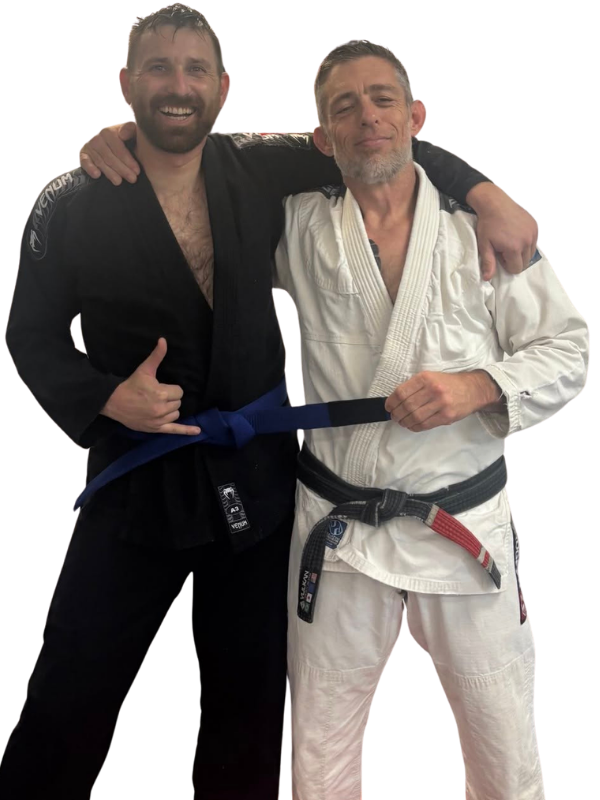
The picture people carry into a first class — a room of young competitive athletes — is not what adult training in a rural county looks like. Our adult classes include people in their twenties through their fifties and beyond: nurses, contractors, teachers, parents whose children train, and people who last did anything physical in high school. Beginners are a permanent feature rather than an occasional intake.
That mix is one of the more useful things about local training. It means the room is not organised around competition, that pace and intensity are already adjusted for people with jobs and responsibilities, and that a new adult is rarely the only person learning something for the first time that evening.
Family scheduling and training together
A large share of adults in Lake County first appear in a class because their child already trains. Stacking family training on the same trip solves the transport problem that otherwise sinks a lot of good intentions, and many parents find it easier to justify the time when it is not an additional journey.
It is worth looking at the schedule with that in mind. Programs for children, teens and adults run across both Middletown and Clearlake, and some evenings line up so that more than one member of a household can train in the same window. Ask when you visit; the practical logistics of a family week are usually the real deciding factor.
Common questions
Parent Pro Tip
Solve for the drive, honestly. In a rural county the activity that survives is the one that fits the commute, the work shift and the other children in the car. A slightly less perfect program eight minutes away will out-perform the ideal one forty minutes away every single time.
- Map the realistic door-to-door time on a weekday, not a Saturday.
- Check whether siblings can be at the same place at the same time.
- Pick the schedule that survives your busiest month.
From the Elevate Martial Arts coaching staff — general guidance, not professional advice.
About the author
Elevate Martial Arts Instructional Team
Coaches, Middletown & Clearlake
Our coaching staff has taught children, teens and adults in Lake County for more than 20 years. Guides in the Learning Center are written from what we see in class each week and reviewed by the instructional team before publishing. They are general educational information, not medical, psychological or legal advice.
About this guide
- Written by Elevate coaches who teach adult classes in Middletown and Clearlake.
- Tuition figures refer to Elevate programs only. Details for other schools change over time — confirm directly with them.
- Reviewed by the Elevate Martial Arts instructional team.
- General educational information only — not medical, psychological or legal advice.