
Key takeaways
- Courage is built through repeated practice, not innate temperament alone.
- Breaking a scary task into small, achievable steps makes courage feel possible rather than overwhelming.
- Celebrating the attempt, not just the successful outcome, reinforces the behavior you want to see again.
- A predictable setting with regular chances to try builds courage more reliably than occasional big challenges.
- Courage-building is about steady practice, not pushing a child past genuine fear or distress.
Courage is a skill, not a fixed trait
It's tempting to sort children into 'brave' and 'shy' as if the label is permanent. In practice, courage behaves more like a skill: something built through repeated, low-stakes practice rather than something a child either has from birth or doesn't. A child who seems hesitant in new situations today can become noticeably more willing to try things after months of small, manageable practice.
This reframe matters for parents because it shifts the question from 'is my child brave enough?' to 'has my child had enough chances to practice doing something a little uncomfortable and see that it goes okay?' The second question has a clear, actionable answer.
Why small steps work better than big leaps
Asking a hesitant child to make a big leap — perform in front of the whole school, join a new team cold, speak up in a large group — usually asks for more courage than they've built yet. When the leap is too big, the likely outcome is refusal or a bad experience, both of which can make the next attempt harder rather than easier.
Breaking a goal into smaller pieces changes the odds. A child terrified of speaking in front of the class might first practice answering one question with just a parent listening, then with one sibling in the room, then in a small group, before ever facing the full class. Each small success becomes evidence the child can draw on for the next, slightly bigger step.
Celebrate the attempt, not only the outcome
If courage only gets recognized when it produces a successful result, a child learns that trying only counts when it works out — which is exactly backward from what builds courage. Recognizing the attempt itself, regardless of outcome, teaches a child that trying is the valuable part, which makes them more willing to try the next time, win or lose.
This can be as simple as noticing out loud: 'You raised your hand even though you weren't sure of the answer — that took courage,' regardless of whether the answer was right.
Practice, not pressure
There's an important difference between building courage through steady practice and pushing a child past genuine fear or distress. The goal is manageable discomfort — a nudge past the edge of a child's comfort zone, not a shove past a wall of real fear. If a child is in genuine distress, backing off to a smaller step is the right move, not persisting.
A useful gut check: if a child tries the small step and it goes reasonably okay, even if imperfectly, that's productive discomfort. If a child is in tears, shutting down, or physically distressed, the step was too big and needs to be scaled back.
- Break a scary goal into the smallest workable first step
- Recognize attempts out loud, separate from results
- Increase difficulty gradually as small steps become comfortable
- Scale back rather than push through if distress is significant
Why consistency matters more than intensity
One intense 'brave' experience — a single big challenge, faced once — rarely builds lasting courage on its own. What tends to work is a steady rhythm: the same kind of small challenge, repeated weekly, so a child accumulates dozens of small proof-points that trying goes okay. This is why activities with a regular schedule tend to build courage more reliably than occasional one-off events, however exciting those events are.
How Elevate can help
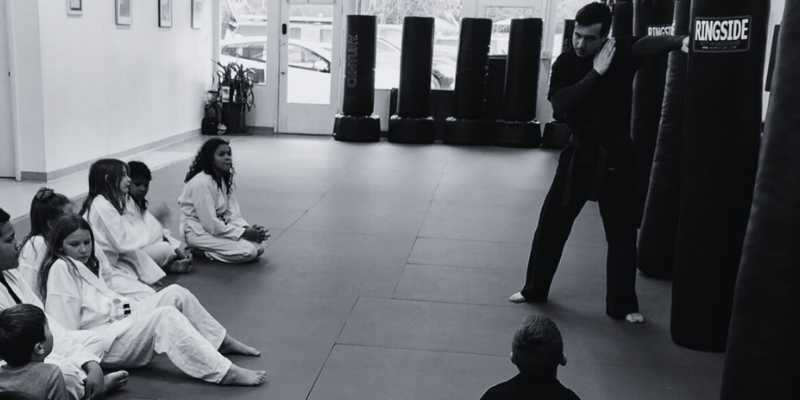
A weekly martial arts class is, structurally, a courage-building program: every class asks a student to attempt something slightly outside their comfort zone, whether that's a new technique, speaking up to answer a question, or leading a line for the first time. Because it happens every week, students accumulate the kind of repeated, small-scale practice that builds courage gradually rather than all at once.
Elevate coaches, trained through the Kovar Systems curriculum and continuing education, are deliberate about pacing this progression — introducing a new challenge only once a student is ready, and adjusting for a student who needs more time on a given step. Individualized instruction means the size of the 'small step' is calibrated to the student in front of the coach, not a fixed curriculum pace.
Consistent class expectations mean students know exactly what will be asked of them, which lowers the uncertainty that makes a new challenge feel bigger than it is. Leadership opportunities — helping a newer student, leading a warm-up, demonstrating for the class — offer some of the most direct, structured courage practice available, and private lessons are available where a student needs individual repetition before trying a step in front of the group. Supportive accountability, from coaches who notice and name a student's attempts, reinforces the habit of trying regardless of the outcome.
When to look beyond everyday coaching
Building courage through steady practice is different from managing a significant fear or anxiety, and it's worth knowing the difference. If your child experiences intense, persistent worry that goes well beyond ordinary hesitation, or if fear is interfering with daily life, sleep, school or relationships, a conversation with your pediatrician or a licensed professional is the appropriate next step. Elevate coaches are not clinicians and do not diagnose or treat anxiety or any other condition; this guide is general educational information only.
Common questions
Parent Pro Tip
Confidence is downstream of competence. Children rarely talk themselves into believing they can do something; they collect evidence. Your job is not to convince them — it is to keep arranging small, honest, slightly-hard reps and then point out what they just did.
- Choose challenges your child can complete in about eight out of ten attempts.
- Describe the effort and the specific action, not the identity: "you kept your hands up", not "you're a natural".
- Let them fail small and often, in places where failure is cheap.
From the Elevate Martial Arts coaching staff — general guidance, not professional advice.
About the author
Elevate Martial Arts Instructional Team
Coaches, Middletown & Clearlake
Our coaching staff has taught children, teens and adults in Lake County for more than 20 years. Guides in the Learning Center are written from what we see in class each week and reviewed by the instructional team before publishing. They are general educational information, not medical, psychological or legal advice.
About this guide
- Written from how Elevate structures its classes, coaching and student support in Middletown and Clearlake.
- General educational information for families. Elevate coaches are not clinicians and do not diagnose or treat anxiety or any other condition. No external research is cited and no outcome is promised.
- Reviewed by the Elevate Martial Arts instructional team.
- General educational information only — not medical, psychological or legal advice.