
Key takeaways
- Getting picked last is usually a signal about perceived skill or familiarity, not a child's likability.
- Acknowledging the sting matters before moving to solutions.
- Building genuine competence in a lower-pressure setting changes the underlying pattern over time.
- Individual progress, tracked privately, protects a child's confidence while skills are still developing.
What being picked last usually signals
When kids pick teams, they're making a quick, often unkind guess about who will help them win. That guess is usually based on visible skill or speed in that specific activity — not on who a child is as a person, and not on how much other kids actually like them.
It rarely feels that way to the child standing there, though. Being picked last in front of a group is one of the more publicly visible small humiliations of childhood, and it's reasonable for it to sting even when the underlying reason is fairly ordinary.
Talking with your child about it
The instinct to immediately reassure ('who cares what they think!') often lands as dismissive, even when it's well-intended. Naming the feeling first — "that's a rough feeling, getting picked last in front of everyone" — tends to open the conversation rather than close it.
From there, it can help to separate the feeling from the fact. The feeling (embarrassment, disappointment) is completely valid. The fact (being picked last at kickball) says something about kickball skill at that moment, not about your child's value as a friend or person.
Why building real competence matters
Reassurance alone doesn't change how the next pickup game goes. What does tend to change the pattern, over time, is a child getting genuinely more capable at something — coordination, confidence moving their body, comfort with physical activity in general — which shows up in how they're picked the next time and, just as importantly, in how sure of themselves they feel walking into the game.
This is easier to build in a setting without the pressure of a live game or an audience of judging peers. A structured class, where nobody is being picked or excluded and everyone progresses at their own pace, is a lower-stakes place to build the underlying skill.
How Elevate can help
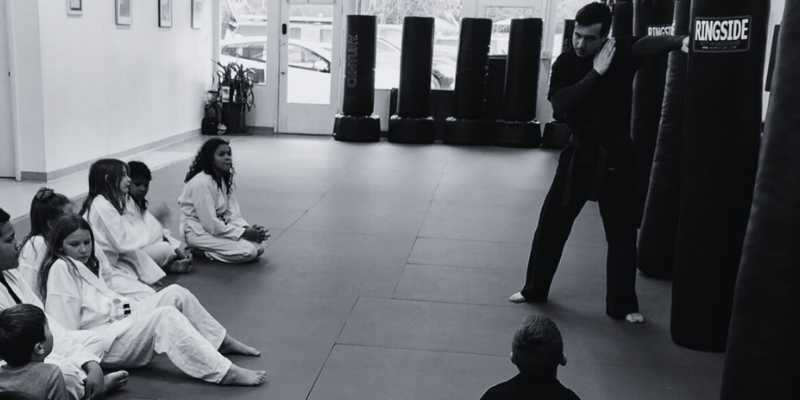
Martial arts class removes the 'picking teams' dynamic entirely — there are no captains, no last pick, no public ranking. Every student works with the partner the coach assigns and progresses through the curriculum at their own pace, which takes away the exact moment that makes team sports sting for a child who isn't yet confident.
Individualized instruction means a coach is tracking each student's personal progress, not comparing them to the fastest kid in the room. Consistent expectations mean the same effort and attention is expected from every student regardless of current skill level, and belts or stripes mark individual progress rather than public ranking against peers.
Because coaches — trained through the Kovar Systems curriculum and continuing education — deliberately assign partners, a less coordinated or less confident student regularly gets paired with a patient, more experienced classmate rather than being left to fend for themselves, and also gets chances, as they improve, to be the more experienced partner for someone newer. That rotation builds real coordination and body confidence over weeks of practice, which is the actual variable that tends to change how a child fares in a pickup game later.
Tigers (5–8) and Dragons (9–12, 45 minutes) build coordination and confidence through age-matched drills; Little Dragons (ages 3–4, 40 minutes) lays the groundwork even earlier with simple balance and body-awareness games, all without a single 'you're not picked' moment.
A few things to avoid
Criticizing the kids who did the picking rarely helps and can make your child feel more like a victim than like someone with agency to improve their situation. Similarly, forcing extra practice in the exact sport where the picking happened, without addressing the underlying comfort and coordination, can add pressure without solving the real issue.
If a coach or teacher allows repeated public 'picking' that seems to consistently target the same few kids, that's worth a respectful conversation with them about the format, not just with your own child about resilience.
Taking the long view
Most adults, looking back, remember being picked last for something at some point in childhood, and it rarely defines how their life turned out. That perspective doesn't make the moment less real for a child today, but it's a useful thing for a parent to hold onto while helping them through it.
Common questions
Parent Pro Tip
Shared activity beats forced conversation. Children make friends sideways — while doing something together — far more easily than face to face. Any setting with the same faces, a shared task and a predictable weekly slot gives friendship a chance to form without a child having to perform.
- Prioritise repetition over variety: the same group every week beats five different ones.
- Arrive five minutes early. Most connection happens before the activity starts.
- Ask "who did you work with?" rather than "did you make a friend?"
From the Elevate Martial Arts coaching staff — general guidance, not professional advice.
About the author
Elevate Martial Arts Instructional Team
Coaches, Middletown & Clearlake
Our coaching staff has taught children, teens and adults in Lake County for more than 20 years. Guides in the Learning Center are written from what we see in class each week and reviewed by the instructional team before publishing. They are general educational information, not medical, psychological or legal advice.
About this guide
- Written from how Elevate structures its curriculum, coaching and partner assignment in Middletown and Clearlake.
- General educational information for families. No external research is cited and no outcome is promised.
- Reviewed by the Elevate Martial Arts instructional team.
- General educational information only — not medical, psychological or legal advice.