
Key takeaways
- Friendship follows repeated contact around a shared task, so schedule beats introduction.
- A second social world outside school gives a teenager somewhere to be when one group goes wrong.
- Parents help most with logistics and transport, and least with commentary on who their teenager should like.
How teenage friendships actually form
Friendships in adolescence are built by accident, on top of proximity. The ingredients are unremarkable: the same people, in the same place, at the same time, doing something that gives them a reason to talk. That is why school, teams and part-time jobs generate friendships and why one-off events rarely do. A single meet-up is an audition; a weekly commitment is a relationship.
This is good news for parents, because logistics are within your control in a way that social chemistry is not. You cannot make anybody click. You can make sure your teenager is in the same room as the same twelve people every Tuesday for six months, which is the condition under which clicking becomes possible.
- Repetition with the same group beats variety
- A shared task removes the pressure to make conversation from nothing
- Mixed ages lower the stakes of adolescent status games
- Environments where effort is respected suit teenagers who are not naturally social
Why a second social world matters
When school is a teenager's only social environment, one falling-out can remove their entire community overnight. A second world — a job, a class, a club, a training night, a volunteer role — changes that arithmetic. It gives them somewhere to go when the first place is difficult, and it means their identity is not entirely determined by one set of opinions formed in year seven.
For teenagers in smaller communities like Middletown and Clearlake, this takes some deliberate effort, because the same young people tend to appear in most settings. It is still worth doing; even a group that overlaps partly with school is usually a different social configuration, with different roles available.
Helping without hovering
The useful parental contributions are unglamorous: driving, paying, being flexible about timings, saying yes to a lift home for someone else, and having a house where people are allowed to be. Almost everything beyond that — commentary on who their friends are, encouragement to talk to a particular person, follow-up questions about how it went — tends to raise the pressure and lower the odds.
Where teenagers do want help, it is usually with the mechanics of a specific situation: what to say when joining a conversation, how to ask someone to do something without it being a big deal, how to leave a group chat that has turned unpleasant. Answer the question they asked, keep it brief, and let them adapt it.
- Say yes to transport more often than is convenient
- Keep questions afterwards to one, or none
- Make your home an easy place for other teenagers to be
- Resist ranking their friends out loud
What a positive peer group actually looks like
Parents often describe wanting a good crowd, which usually means something more specific: a group where effort is normal, where people notice absence, and where the status system rewards something other than risk-taking. Environments with adults present and a real task in the middle tend to produce that more reliably than unstructured hanging out, though there are no guarantees anywhere.
It is also worth being realistic about influence. You are unlikely to talk a teenager out of a friendship group, and attempting it usually strengthens it. Adding options works better than removing them: more places to belong makes any single group less structurally necessary.
Why training rooms often work for this
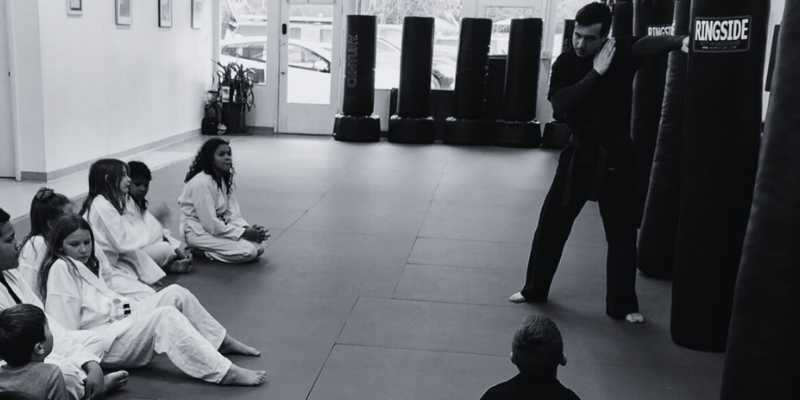
Martial arts classes have a few features that suit teenagers who find open social settings hard. There is a task, so nobody has to invent conversation. Partners rotate, so contact is built in. Ages mix, which flattens the hierarchy — a sixteen-year-old training beside a thirty-year-old nurse and a retired contractor is in a very different social frame than they are at lunch. And attendance is repeated weekly, which is the actual mechanism.
At our Middletown and Clearlake locations, teens train on the adult schedule with supervised partnering. Many teenage students tell us the friendships came from the drilling rather than from anything social that was arranged, which matches how this usually works. It is one option among many; a job, a band, a robotics club or a trail crew can do the same job.
If your teenager is persistently isolated, distressed about it, or being targeted, involve the school and consider speaking with a qualified professional.
Signs worth paying closer attention to
Most teenagers go through periods of social difficulty and come out of them. The patterns worth a closer look are longer-running: no contact with anyone outside school hours for months, a sudden and total drop of an entire friendship group, reluctance to attend school, or a shift towards a group where your teenager seems noticeably more anxious rather than more relaxed.
Those are conversations to have without an immediate solution attached, and often conversations to have with the school as well. Being on the outside is painful in a way that is easy for adults to underestimate, and taking it seriously is usually more helpful than fixing it quickly.
Surviving the first few weeks of anything new
The awkward stretch at the start of a new group is the part that ends most attempts. For the first two or three sessions a teenager will usually know nobody, stand at the edge, and come home reporting that it was fine, which means nothing. Knowing in advance that this is the normal shape of it helps both parent and teenager avoid treating early discomfort as evidence of a bad fit.
Small things shorten it: arriving a few minutes early rather than late, having one question ready to ask someone, and going every week rather than every other week. Attendance gaps reset the social clock, which is why an inconvenient but consistent schedule usually beats a convenient but irregular one.
- Commit to six sessions before judging the fit
- Arrive early — conversations happen before, not during
- Learn two names each week
- Avoid missing weeks in the first month
For teenagers reading this
If you are the one who feels on the outside, the useful thing to know is that almost nobody makes friends by being interesting. They make friends by being around. Pick something that meets every week, keep going for two months, and be the person who turns up. That single behaviour does more than any advice about conversation.
It is also worth knowing that most rooms contain other people who feel exactly the way you do and are hiding it competently. Asking someone a small, practical question — how long have you trained here, what did the coach just say, do you want to partner — is usually enough, and it does not require being confident. It only requires being willing to be slightly awkward for about four seconds.
Common questions
Parent Pro Tip
Trade control for connection where you can, and hold the two or three lines that actually matter. Teenagers accept boundaries far better from an adult who is clearly on their side about everything else, and they need at least one adult outside the family who notices when they show up.
- Choose your non-negotiables deliberately; let the rest be theirs.
- Find one setting where an adult who is not you knows their name.
- Ask about the thing they care about before the thing you care about.
From the Elevate Martial Arts coaching staff — general guidance, not professional advice.
About the author
Elevate Martial Arts Instructional Team
Coaches, Middletown & Clearlake
Our coaching staff has taught children, teens and adults in Lake County for more than 20 years. Guides in the Learning Center are written from what we see in class each week and reviewed by the instructional team before publishing. They are general educational information, not medical, psychological or legal advice.
About this guide
- Written from what Elevate coaches see week to week with teenage students in Middletown and Clearlake.
- General educational information for families. No external research is cited, no organisation is described on the family's behalf, and no outcome is promised.
- Reviewed by the Elevate Martial Arts instructional team.
- General educational information only — not medical, psychological or legal advice.