
Key takeaways
- Aim for competence in specific situations, not a change in temperament.
- Every time an adult answers for a child, a repetition is lost.
- Rehearse the exact words at home; improvisation is the hardest part for quiet kids.
Quiet is not the problem — being stuck is
Plenty of children are naturally reserved and remain so as thoroughly capable adults. Introversion is not a deficit and does not need fixing. What is worth addressing is being stuck: unable to ask a teacher for help, unable to tell a friend to stop, unable to order food, unable to join a group that would happily have them.
Separating those two things lowers the pressure for everybody. The goal is not a child who talks more. It is a child who can do the four or five specific things that everyday life requires, at whatever volume suits them. Framed that way, progress becomes measurable and does not require your child to become someone else.
The habit that quietly stalls progress
When an adult asks a shy child a question, there is a pause, and most parents fill it. It is kind, it rescues the child from a visible silence, and it removes the repetition. Over a year, a child who is spoken for a few times a week loses hundreds of practice opportunities and receives a consistent message: this is handled for you.
The fix is uncomfortable and simple — wait. Let the silence run for a few seconds longer than feels polite. If it is clear your child cannot manage it, prompt rather than replace: "you can tell her" or "do you want to say it or should I?" The second version keeps the choice with them and often produces a mumbled answer, which counts.
- Count to five before filling a silence
- Prompt instead of substituting: "you can tell them"
- Warn them beforehand that they will be asked something
- Do not apologise for their quietness in front of them
- Never label them "the shy one" in company
Four scripts worth rehearsing
Improvising words under social pressure is the hardest part for a quiet child, so give them the words in advance. Four scripts cover most of what a child needs, and each can be rehearsed at home in under a minute. Practise them as literal sentences rather than as ideas, and use the same wording every time until it is automatic.
Rehearsal works best when it is light and slightly silly — you play the teacher badly, they correct you. Formal role-play makes many children more self-conscious, not less. The point is that when the moment arrives, the sentence is already familiar in their own mouth.
- Asking for help: "I don't understand this part. Can you show me again?"
- Joining: "Can I play?" or, for older kids, standing nearby and asking what they are doing
- Saying no: "I don't want to do that." Repeated, unchanged, without justification
- Reporting: "Something happened and I need to tell you about it."
A graded ladder of real practice
Confidence comes from completed repetitions, so the ladder should start low enough that success is nearly certain. Ordering their own drink while you stand beside them is a genuine rung. So is handing over the money, asking where the restrooms are, or telling the coach their belt came loose.
Move one rung at a time and let each one become boring before adding the next. If a rung fails, do not remove it — repeat it in an easier setting. The single most common mistake is jumping from ordering a drink to expecting a child to introduce themselves to a room of new peers.
- Say thank you to a server, out loud
- Order their own food with you standing there
- Ask a shop worker where something is
- Ask the coach a question at the end of class
- Introduce themselves to one new student
- Tell a friend, in the moment, that they do not want to do something
Why a structured class gives usable repetitions
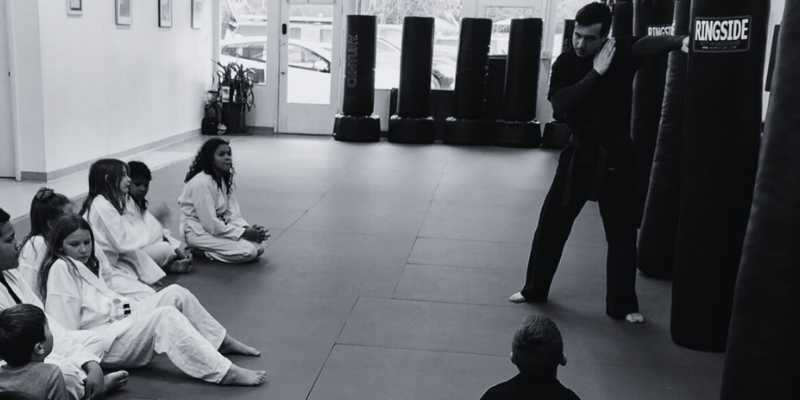
The reason a martial arts class tends to help quiet students is not the fighting; it is the structure. There is a script for almost everything — how to line up, how to greet a partner, what to say when you need to sit out, how to ask for a correction. A child who is uncomfortable inventing social behaviour is handed the words and the sequence, and then repeats them twice a week.
There is also a rotation of partners, which means a student practises the first thirty seconds with a new person again and again in a supervised room where nobody is excluded. Coaches at both Middletown and Clearlake will deliberately give a quiet student small speaking jobs — counting a set, leading a line — once they are ready. Tell us your child is working on this and we will pace it with you.
Ordinary shyness is common and usually eases with practice. If your child's fear of speaking is intense, appears in most settings or stops them attending school, talk with your pediatrician or a qualified professional.
What to say before and after
Before a hard moment, keep it short and factual: what will happen, what they will say, and that you will be right there. Long reassurance tends to inflate the event. Afterwards, comment on the doing rather than the result — "you asked him" is better than "see, that wasn't scary," which contradicts what the child actually felt.
Avoid retelling the story to other adults in front of them, even proudly. For a self-conscious child, being discussed is often harder than the original task, and it can quietly undo a good week.
Self-advocacy at school
School is where the cost of not speaking up compounds fastest. A child who cannot say they did not understand will fall behind quietly, often for months, and the gap is usually discovered long after it opened. That makes asking a teacher for help one of the highest-value scripts on the list, and one worth rehearsing until it is boring.
It also helps to give your child the mechanics, not just the words: when to ask, who to approach, and what to do if the first attempt does not work. Many quiet children try once, get a rushed answer, and conclude the approach failed. Teaching a second attempt — asking again at a different moment, or writing the question down — turns a single brittle skill into a usable one.
- Rehearse the exact sentence for asking a teacher for help
- Agree when to ask: during work time rather than mid-instruction
- Have a written fallback if speaking in the moment is too hard
- Plan the second attempt in advance so one failure does not end it
- Let them email or speak to the teacher before you do
Common questions
Parent Pro Tip
Confidence is downstream of competence. Children rarely talk themselves into believing they can do something; they collect evidence. Your job is not to convince them — it is to keep arranging small, honest, slightly-hard reps and then point out what they just did.
- Choose challenges your child can complete in about eight out of ten attempts.
- Describe the effort and the specific action, not the identity: "you kept your hands up", not "you're a natural".
- Let them fail small and often, in places where failure is cheap.
From the Elevate Martial Arts coaching staff — general guidance, not professional advice.
About the author
Elevate Martial Arts Instructional Team
Coaches, Middletown & Clearlake
Our coaching staff has taught children, teens and adults in Lake County for more than 20 years. Guides in the Learning Center are written from what we see in class each week and reviewed by the instructional team before publishing. They are general educational information, not medical, psychological or legal advice.
About this guide
- Written from what Elevate coaches see week to week in Middletown and Clearlake classes.
- General educational information for families. No external research is cited and no outcome is promised.
- Reviewed by the Elevate Martial Arts instructional team.
- General educational information only — not medical, psychological or legal advice.