
Key takeaways
- Early preschool progress often appears in routines and recovery before it appears in polished technique.
- Expect uneven weeks; compare the child with their own baseline several months ago, not with another child in the room.
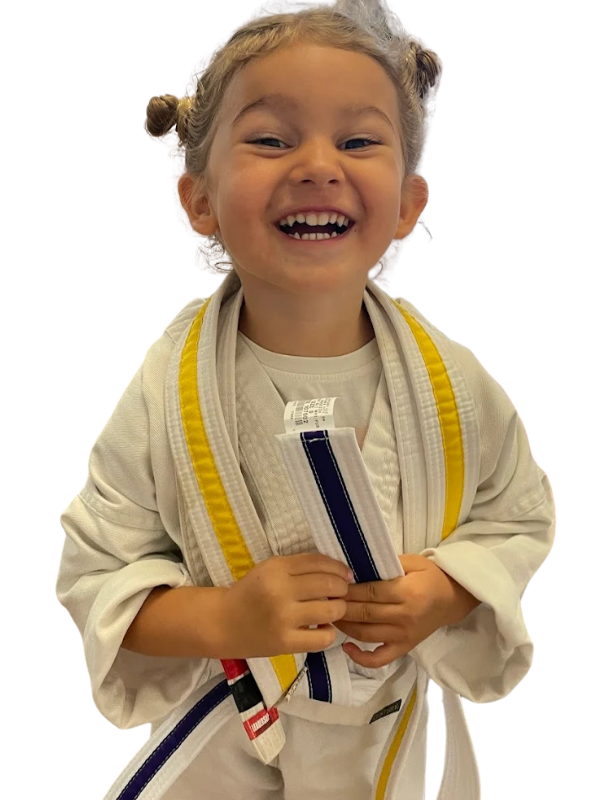
- Rewards and belts can mark progress, but they should point back to effort and skill rather than become the reason the child participates.
Month one: learning the room
The first month is mostly orientation. The child is learning who the coach is, where shoes go, how class starts, which sounds mean stop, how close other children stand and whether the parent really does come back at the end. Technique is happening, but much of the child's mental work is spent on the environment itself.
A successful first month may look like nothing more than entering with less resistance and joining the first activity faster. That is not small. Familiarity frees attention for everything that comes next.
Months two and three: routines begin to belong to the child
Once the room is familiar, children can carry more of the routine themselves. They find their spot, know the line-up, recognize common drills and understand what 'switch' means. This is often when parents notice fewer reminders and more anticipation.
Technique also becomes easier to see because the child is no longer spending all their attention decoding the class. Movements start to look recognizable. More importantly, the child can respond to a correction and try again without losing the whole thread.
Months four to six: from participation to ownership
By this stage, many children begin to identify with the activity: this is my class, my belt, my coach, my friends. That sense of belonging can change attendance from something the parent imposes to something the child expects as part of the week.
The more meaningful progress is increased ownership. The child carries gear, remembers rules, helps put equipment away, notices when a newer child does not know what to do, and can tolerate slightly harder technical work. Not every child follows this timeline, but the direction is useful.
The invisible skills that deserve to count
Parents understandably notice kicks. Coaches also notice how the child handles waiting, whether they can stop power, whether they recover from being corrected, whether they can be paired with a different child without protest, and whether they rejoin after distraction.
These are often the skills that make the activity sustainable. A technically talented preschooler who cannot safely work around others has less useful progress than a less coordinated child who has learned how to participate, control force and keep trying.
- Arrives and separates more easily
- Needs fewer reminders for familiar routines
- Stops the body faster on cue
- Recovers after mistakes with less adult support
- Can work near different children safely
- Carries small responsibilities without prompting
Expect plateaus, regressions and strange Tuesdays
Progress at this age is not a staircase. A child can look dramatically more capable for two weeks, then have three difficult classes in a row. Illness, sleep, family changes, preschool transitions and simple developmental bursts all affect what shows up in the room.
Do not respond to every dip by changing the plan. Look for trends over a month. If the child still wants to attend and the instructor sees continued engagement, a rough patch may just be a rough patch.
Belts, stripes and rewards: useful markers, poor fuel
Visible recognition helps preschoolers connect effort with time because six months is otherwise an abstract idea. A belt or stripe can say, 'you kept coming and learning.' That can be valuable.
The problem comes when every conversation becomes about the next object. Keep translating the marker back into behavior: 'that stripe is for the months you practiced,' not 'you need to get another stripe.' The reward should point backward at the work rather than pull the child forward like bait.
Comparison is especially misleading at ages three and four
Two children with the same birthday can differ enormously in language, size, group experience, impulse control, confidence with adults and motor coordination. Comparing them class by class tells you almost nothing useful.
The cleaner comparison is to your own child three months ago. Are they doing more independently? Are they safer? Are they more willing to attempt? Do they understand the room better? That is the progress line that matters.
When to reassess whether the activity still fits
Not every good activity stays good forever. Reassess if the child has been persistently distressed for weeks, if the class no longer challenges them at all, if the schedule is harming family life, or if the coaching environment has changed in a way you do not like.
A decision to stop or switch is not a failure when it is considered rather than impulsive. Finish an agreed short period if reasonable, talk with the coach, and make the next choice based on what you learned about the child rather than on a story that they 'quit.'
Common questions
About the author
Elevate Martial Arts Instructional Team
Coaches, Middletown & Clearlake
Our coaching staff has taught children, teens and adults in Lake County for more than 20 years. Guides in the Learning Center are written from what we see in class each week and reviewed by the instructional team before publishing. They are general educational information, not medical, psychological or legal advice.
About this guide
- Written from what Elevate coaches see week to week in Little Dragons classes for ages 3–4 in Middletown.
- General educational information for parents. It is not medical, developmental, psychological or diagnostic advice, and no outcome is promised.
- Reviewed by the Elevate Martial Arts instructional team.
- General educational information only — not medical, psychological or legal advice.