
Key takeaways
- Watch the correction of the weakest student in the room.
- Names, eye level and specific feedback matter more than rank.
- Safety management is visible within ten minutes of watching.
- You are choosing a long-term mentor; relational skill matters more than competitive record.
- Corrections should be specific, immediately retried and emotionally neutral.
What to watch during a class
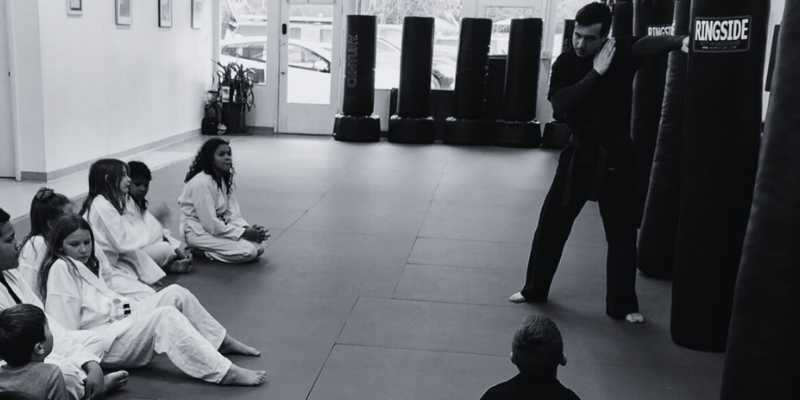
You will learn most from the students who are struggling. How they are spoken to tells you what your child's hard weeks will look like.
- Does the instructor use students' names without prompting?
- Do they crouch to a child's eye level to correct?
- Is feedback specific, or just "good job" on repeat?
- Are contact levels clearly set and enforced?
- Do senior students look after newer ones?
Parent Pro Tip
The tell is what a coach does when nothing is going wrong. Are they scanning the room and adjusting, or waiting for the drill to end?
Questions worth asking
Good schools answer these easily. Vague answers are information too.
- How are students grouped and paired?
- How is progression decided?
- What is the policy on contact and sparring for this age group?
- What does the total monthly cost include?
Red flags
Guaranteed outcomes, pressure to sign long contracts on a first visit, shaming as a motivational tool, or a refusal to let you watch a class. Any one of those is a reason to keep looking.
Parent Pro Tip
Any adult who requires a child to earn basic respect through performance is teaching something you did not sign up for.
You are choosing a mentor, not a technician
For a child, an instructor is one of a very small number of non-family adults who will see them weekly for years, hold a standard for them, and notice whether they showed up. Frameworks like the Search Institute's developmental relationships model describe what makes that kind of relationship useful: expressing care, challenging growth, providing support, sharing power and expanding possibilities.
That list is a surprisingly good specification for a martial arts instructor, and it maps onto things you can observe. Care looks like knowing names and noticing absences. Challenge looks like corrections given to everyone, including the weakest student. Support looks like breaking a task down rather than repeating it louder. Sharing power looks like students being asked questions rather than only told answers.
Technical skill matters, but it is table stakes and it is also the thing most parents cannot assess. The relational skill is the thing you can assess, and it is the thing that determines whether your child is still training in two years.
How to read a correction
Almost everything you need to know shows up in how mistakes are handled. A good correction is specific, actionable, immediately retried, and emotionally neutral. It tells the student exactly what to change and gives them a chance to change it while the attempt is fresh.
A poor correction is a verdict. "No, wrong" or "come on, concentrate" contains no information, and repeated often enough it teaches a child that trying produces disapproval. Watch for the difference over ten minutes and it becomes very obvious.
- Good: "Step your left foot out first — try it again now." Specific, actionable, immediate retry.
- Good: "That's the right idea, the timing's early. Wait until they move."
- Poor: "That's wrong." No next action.
- Poor: "You're not listening." A judgment about the child, not the technique.
- Poor: silence — the child repeats the error twenty times with no input at all.
Parent Pro Tip
Listen for corrections given to the strongest student in the room. Coaches who only correct beginners are managing a class; coaches who correct everyone are teaching one.
Safety culture is a coaching quality, not a policy document
Safety in a contact activity is created continuously by the person on the floor. Policies matter, but what you are watching for is whether intensity is actively managed — pairings adjusted for size and experience, drills stopped when they get wild, and clear norms about control.
Ask directly how sparring intensity is regulated and how new students are paired. A confident, specific answer is a good sign. Vagueness, or an implication that toughness is the point, is worth taking seriously.
- Are beginners paired with experienced students or with each other?
- What is the stated rule for contact level, and does the room follow it?
- How does a student signal that they need to stop, and does the coach reinforce it?
- Are injuries and near-misses discussed openly?
- Is there a plan for a student who needs to step off the mat for a minute?
Questions worth asking before you commit
You are entitled to ask all of these and a good school will answer them without defensiveness. How the questions are received is itself part of the answer.
- Who will teach my child's class each week, and how often does that change?
- How are your instructors trained, and is there ongoing development?
- How do you handle a child who is struggling or disruptive?
- What does the total monthly cost include, and what is billed separately?
- Can I watch a full class before enrolling?
- How do you communicate with parents about progress?
Ask the same set at every school you visit. The comparison is more informative than any individual answer.
Common questions
Parent Pro Tip
Watch the coach for ten minutes and count two things: how many times they use a child's name, and how many corrections come with a specific next action rather than a judgment. Those two numbers will tell you more about the next two years than the instructor's competition record ever will.
- Watch a normal class at the time you would actually attend.
- Count names used and specific corrections given.
- Watch what happens to the least confident child in the room.
From the Elevate Martial Arts coaching staff — general guidance, not professional advice.
Where to read more
- Search InstituteDevelopmental relationships framework — the five elements of a relationship that helps a young person grow
- Harvard Center on the Developing ChildWhy at least one stable, supportive adult relationship is the most common factor in children who do well after hardship
- CASELThe five areas of social and emotional learning: self-awareness, self-management, social awareness, relationship skills and responsible decision-making
About the author
Elevate Martial Arts Instructional Team
Coaches, Middletown & Clearlake
Our coaching staff has taught children, teens and adults in Lake County for more than 20 years. Guides in the Learning Center are written from what we see in class each week and reviewed by the instructional team before publishing. They are general educational information, not medical, psychological or legal advice.
About this guide
- Written from what Elevate coaches see week to week in Middletown and Clearlake classes.
- General educational information for families. No external research is cited and no outcome is promised.
- Where this guide points to public health or education guidance, the organisation is named and linked so you can read the original.
- Reviewed by the Elevate Martial Arts instructional team.
- General educational information only — not medical, psychological or legal advice.