Key takeaways
- Martial arts addresses every standard component of PE within one class rather than across a term.
- Participation is close to total — there is no bench, no outfield and no waiting for a turn at bat.
- The progression model builds a habit of measuring yourself against your own last attempt, which is what makes activity stick into adulthood.
The components of PE, and how a class covers them
Physical education is usually described in terms of health-related fitness, skill-related fitness, movement competence and personal and social responsibility. A martial arts class touches all four every session, which is unusual.
- Cardiovascular endurance — warm-ups, rounds, drilling and live practice.
- Muscular strength and endurance — bodyweight work, grappling, holding positions and controlled striking.
- Flexibility — structured stretching and range-of-motion work built into every class.
- Balance, agility and coordination — stance work, footwork, direction changes and falling safely.
- Motor competence — sequencing multi-step movements accurately under mild pressure.
- Personal and social responsibility — partner safety, respect, self-control and effort under supervision.
Participation is the underrated part
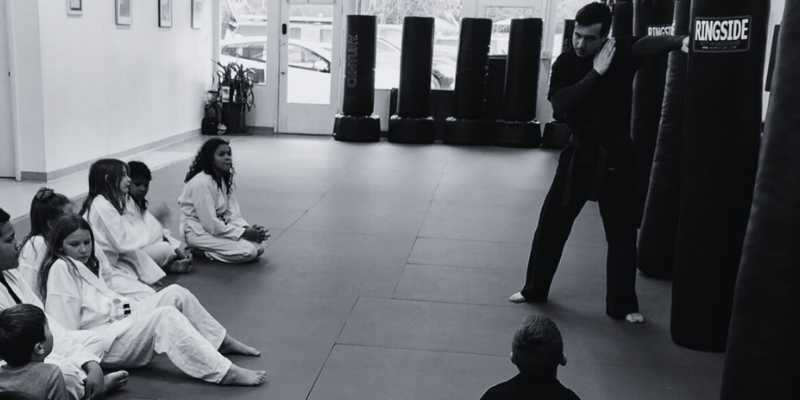
The biggest weakness of many PE settings is time on task. In a large group game, a substantial share of the period is spent standing, waiting or watching. On a mat, every student is drilling at the same time, usually with a partner, for nearly the whole class.
This matters most for the children PE tends to fail: the less athletic, the less confident and the ones who learn to disappear at the back. There is nowhere to hide in a partner drill, and that turns out to be a good thing when the coach's job is to notice you.
Progression that a record can show
PE plans and charter reporting generally want evidence of progression, not just activity. Martial arts has that built in. Curriculum is organized into levels, each level has defined skills, and evaluations are scheduled rather than improvised.
That gives a parent something concrete to write down: skills worked, sessions attended, level reached. It also gives the student something concrete to aim at, which is a different kind of usefulness.
The lifelong-activity argument
One stated purpose of physical education is to produce adults who keep moving. Most youth sports end at eighteen, and for many students they end far earlier than that. Martial arts is one of the few physical activities a person can genuinely continue for decades — we teach adults who started as children and adults who started at forty.
That continuity is worth weighing. An activity the whole family can do, and that a student can carry into adulthood, tends to outlast one they will age out of.
How this looks at Elevate
We teach a blended curriculum, so students rotate through striking, grappling, self-defense, coordination and fitness rather than repeating one narrow skill set. For a PE plan, that breadth is an advantage: the physical demands vary across the year and different students find their footing at different points in the rotation.
Classes run year-round at Middletown and Clearlake, ages are grouped narrowly, and both group classes and private lessons are available. A first class is complimentary if you would like to see whether it fits your plan.
Common questions
Parent Pro Tip
Solve for the drive, honestly. In a rural county the activity that survives is the one that fits the commute, the work shift and the other children in the car. A slightly less perfect program eight minutes away will out-perform the ideal one forty minutes away every single time.
- Map the realistic door-to-door time on a weekday, not a Saturday.
- Check whether siblings can be at the same place at the same time.
- Pick the schedule that survives your busiest month.
From the Elevate Martial Arts coaching staff — general guidance, not professional advice.
About the author
Elevate Martial Arts Instructional Team
Coaches, Middletown & Clearlake
Our coaching staff has taught children, teens and adults in Lake County for more than 20 years. Guides in the Learning Center are written from what we see in class each week and reviewed by the instructional team before publishing. They are general educational information, not medical, psychological or legal advice.
About this guide
- Written from what Elevate coaches hear from Lake County families in Middletown and Clearlake each week.
- Local organizations, parks and schools are named for orientation only. Schedules, fees and eligibility change — confirm current details directly with each organization.
- General educational information. No external research is cited and no outcome is promised.
- Reviewed by the Elevate Martial Arts instructional team.
- General educational information only — not medical, psychological or legal advice.