
Key takeaways
- Age-appropriate teaching changes the delivery, not the seriousness of the standard.
- Short cycles of explain-do-reset usually teach preschoolers more than long demonstrations followed by one chance to perform.
- A playful class should still have strong boundaries, predictable transitions and an instructor clearly in charge of the room.
The same broad idea can require a completely different lesson
An older child can watch a multi-step demonstration, hold the sequence in memory, partner up and work on it for several minutes. A preschooler usually needs the same idea reduced to one visible action, followed immediately by a chance to do it. That does not mean the preschooler is incapable. It means the lesson has to fit the amount of information they can use in the moment.
A good program can have a progression from Little Dragons into older kids classes while changing how the content is delivered at each stage. The mistake is assuming consistency means identical instruction.
Attention is something the class design earns
Adults sometimes ask how a coach 'makes' three-year-olds pay attention. The more useful answer is that the coach avoids spending attention badly. A thirty-second explanation with a clear demonstration can succeed where a three-minute speech fails, even if the speech is excellent.
Preschool instructors need to notice when attention is decaying and move. More words rarely repair it. Change the visual, change the task, let the child perform, or reset the group physically. This is skilled teaching, not entertainment.
What the games are actually doing
A game should have a training purpose underneath it. Freeze games practice stopping the body. Obstacle courses practice balance, direction changes and spatial awareness. Pad races can practice stance, distance and returning to a line. Animal movements build coordination and create a shared vocabulary for shapes children understand immediately.
The test is whether the coach could tell you what the game is rehearsing. If the answer is simply 'they like it,' the class may be fun but not especially instructional. If the answer is clear and the children are getting many repetitions, play is functioning as curriculum.
Preschoolers need the room to explain itself
Marked spots, lines, cones and obvious equipment stations reduce the amount of language required. 'Stand on a red spot' is easier to process than a paragraph about personal space. A row of targets tells a child where the action belongs. A consistent shoe area makes the arrival routine physical rather than verbal.
This is one reason a room can feel calm even while children are moving quickly. Good visual structure keeps forty small decisions from becoming forty verbal corrections.
Correction should be short enough that the child can use it
A preschooler does not need a technical dissertation. They need one adjustment they can attempt immediately: 'feet wider,' 'hands up,' 'freeze after the kick.' When that works, the coach can add the next piece later.
Public embarrassment is also unnecessary. Young children are still learning what correction means, and a good instructor makes it routine and unemotional. The tone should communicate: this is something we fix, not something wrong with you.
Longer is not automatically better
For preschoolers, a forty-minute class can contain a great deal of work when the pace is appropriate. Extending the class does not create more learning if the final twenty minutes are spent managing exhausted attention. Quality of repetitions matters more than the clock.
That is why Elevate's Little Dragons class is deliberately shorter than older youth training. We would rather finish while the group can still respond than use an adult idea of value where more minutes must always mean more program.
Playful is not the same as chaotic
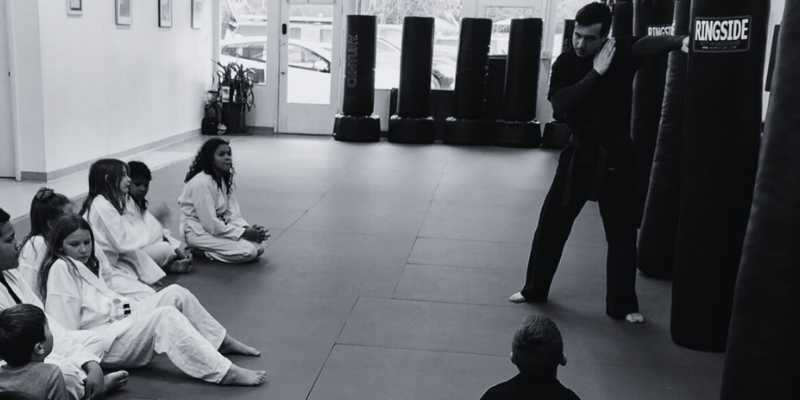
A strong preschool class may include laughter, running and imagination while still having unmistakable structure. The coach starts and stops activities. Children know where to return. Equipment is used for a specific purpose. Safety rules are immediate. Transitions are fast. The room has energy without being ownerless.
Watch what happens after excitement peaks. Can the coach bring the group back within a reasonable moment without shouting or threatening? That recovery tells you more about the quality of the program than whether the class looked perfectly quiet.
What to watch when you visit a preschool program
Spend less time evaluating how impressive the techniques look and more time watching how the adults manage ordinary preschool behavior. Notice the child who wanders, the child who is shy, the child who rushes ahead and the child who cannot wait. Those children reveal the teaching system.
You are looking for adults who get physically closer, simplify, redirect and return the child to success. Constant yelling, long periods in line, humiliation, or expecting older children to police younger ones are all useful reasons to keep looking.
Common questions
About the author
Elevate Martial Arts Instructional Team
Coaches, Middletown & Clearlake
Our coaching staff has taught children, teens and adults in Lake County for more than 20 years. Guides in the Learning Center are written from what we see in class each week and reviewed by the instructional team before publishing. They are general educational information, not medical, psychological or legal advice.
About this guide
- Written from what Elevate coaches see week to week in Little Dragons classes for ages 3–4 in Middletown.
- General educational information for parents. It is not medical, developmental, psychological or diagnostic advice, and no outcome is promised.
- Reviewed by the Elevate Martial Arts instructional team.
- General educational information only — not medical, psychological or legal advice.