
Key takeaways
- Children often overestimate how much other people notice and remember their embarrassing moments.
- Embarrassment is a normal, temporary emotion — the goal is recovery, not prevention.
- How a parent reacts in the moment (calm, not minimizing) shapes how big the moment feels afterward.
- Repeated small experiences of an awkward moment passing without lasting damage build a child's tolerance for future ones.
- Persistent avoidance of everyday situations due to fear of embarrassment is worth discussing with a pediatrician or licensed professional.
Why an embarrassing moment feels enormous
Adults have decades of evidence that most embarrassing moments are forgotten by everyone else within a day. Children don't have that evidence yet. When a child trips in the hallway or gives a wrong answer out loud, it can genuinely feel to them like the whole room will remember it forever.
This is sometimes called the 'spotlight effect' — the sense that everyone is watching and judging as closely as we're watching and judging ourselves. It's a normal part of how self-awareness develops, particularly from around age seven through the teen years, and it fades with experience rather than with explanation alone.
Embarrassment is not the same as shame
It helps to separate embarrassment from shame. Embarrassment says 'that was awkward.' Shame says 'something is wrong with me.' Embarrassment is short-lived and situational; shame lingers and generalizes. Most childhood embarrassing moments are just embarrassment — uncomfortable but temporary — unless the response from the people around a child turns it into something bigger.
This is exactly where adult reactions matter most. A child who trips and hears an adult laugh at them, or gets teased about it later at home, can have an ordinary embarrassing moment turned into a lasting story about being clumsy or 'the kid who always messes up.' The same moment, met with a shrug and 'that happens to everyone,' usually passes in minutes.
How to respond when it happens
Name the feeling without amplifying it: 'That felt embarrassing, huh?' tells a child their reaction makes sense without dwelling on it. Resist the urge to either dismiss it ('it's not a big deal, forget it') or over-comfort it ('oh no, that's terrible, are you okay?') — both can accidentally signal that the moment was worse than it was.
Keep your own reaction calm and slightly matter-of-fact. Children take cues from an adult's face and tone more than from the words used. If you stay steady, the moment reads as manageable. If you look alarmed or overly sympathetic, it can read as confirmation that something bad just happened.
- Acknowledge the feeling briefly, then move on
- Avoid laughing at the moment or retelling it later as a joke
- Share (briefly) a time something similar happened to you
- Resist swooping in to fix or prevent every awkward moment
Building tolerance over time
Because embarrassment tolerance is built through experience, not explanation, children benefit from low-stakes settings where small awkward moments happen regularly and clearly don't end the world. A missed shot in front of teammates, a forgotten line in a school play, a wrong answer in class — each survived moment is evidence that the feared outcome (permanent judgment) doesn't actually happen.
Group settings with a steady, supportive culture are particularly useful here, because the same peers see a child recover from an awkward moment week after week, which quietly proves the point better than any conversation could.
How Elevate can help
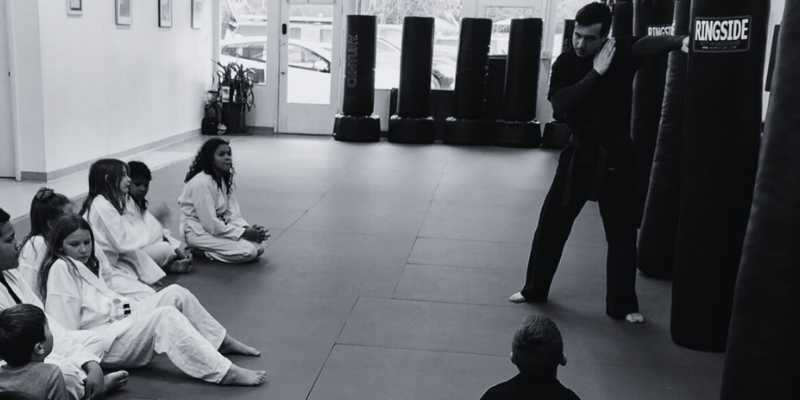
A martial arts class is a room full of small, public, forgettable mistakes — a missed kick, a fumbled combination, forgetting the next move in a pattern in front of the group. Because this happens to every student, every class, it becomes ordinary rather than remarkable, which is exactly the repeated experience that shrinks embarrassment over time.
Elevate coaches, trained through Kovar Systems and ongoing continuing education, are deliberate about how they respond to a student's mistake in front of the group — briefly, kindly, and by immediately redirecting attention to the next attempt. That consistent response models exactly the recovery pattern parents are trying to teach at home.
Individualized pacing means a student isn't compared publicly against classmates who are further along, and private lessons are available for a student who needs more repetition before trying a skill in front of the group. Leadership opportunities, like helping a newer student, also give kids practice being on the other side of someone else's awkward moment — seeing firsthand how quickly the room moves on.
When to look beyond everyday coaching
Feeling embarrassed sometimes, and even replaying a moment for a day or two, is a normal part of childhood. If a fear of embarrassment is leading your child to avoid school, friendships or everyday activities, or if the distress seems out of proportion and isn't easing with time, it's worth speaking with your pediatrician or a licensed professional. Elevate coaches are not clinicians and do not diagnose or treat anxiety or any condition.
Common questions
Parent Pro Tip
Confidence is downstream of competence. Children rarely talk themselves into believing they can do something; they collect evidence. Your job is not to convince them — it is to keep arranging small, honest, slightly-hard reps and then point out what they just did.
- Choose challenges your child can complete in about eight out of ten attempts.
- Describe the effort and the specific action, not the identity: "you kept your hands up", not "you're a natural".
- Let them fail small and often, in places where failure is cheap.
From the Elevate Martial Arts coaching staff — general guidance, not professional advice.
About the author
Elevate Martial Arts Instructional Team
Coaches, Middletown & Clearlake
Our coaching staff has taught children, teens and adults in Lake County for more than 20 years. Guides in the Learning Center are written from what we see in class each week and reviewed by the instructional team before publishing. They are general educational information, not medical, psychological or legal advice.
About this guide
- Written from how Elevate structures its classes, coaching and student support in Middletown and Clearlake.
- General educational information for families. Elevate coaches are not clinicians and do not diagnose or treat anxiety or any other condition. No external research is cited and no outcome is promised.
- Reviewed by the Elevate Martial Arts instructional team.
- General educational information only — not medical, psychological or legal advice.